
Author: Ailen

  • How To Lower Your Car Insurance Rates

    Car insurance rates can change even when your driving habits do not. The good news is that several parts of your premium are within your control: the insurer you choose, your deductibles, optional coverages, annual mileage, discounts, vehicle choice, and—where state law allows—credit-based insurance information.

    The goal is not to strip away protection just to make the price look cheaper. A better strategy is to remove waste, compare equivalent policies, and make changes that fit your actual finances and driving habits.

    Quick takeaways

    • Compare quotes using the same liability limits, deductibles, and optional coverages.
    • Raise deductibles only if you could comfortably pay the higher amount after a covered claim.
    • Review collision and comprehensive coverage on older, lower-value vehicles.
    • Ask your insurer to review every discount for which you may qualify.
    • Update mileage, drivers, garaging address, and vehicle use when your circumstances change.
    • Do not reduce liability limits simply to reach the lowest possible premium.

    The fastest ways to lower car insurance rates

    StrategyPotential impactMain trade-off
    Compare multiple insurersOften one of the highest-impact stepsRequires comparing equivalent policies
    Increase deductiblesCan reduce collision/comprehensive costMore money out of pocket after a covered claim
    Remove unnecessary optional coverageCan materially reduce premiums on some older carsYou accept more repair/replacement risk
    Use discounts and bundlingVaries widely by insurerA bundle is not automatically the cheapest total package
    Report lower mileage or changed vehicle useCan help when your driving has meaningfully decreasedSavings depend on carrier and state
    Try usage-based insuranceCan reward lower-risk drivingSome programs use driving data and may affect pricing differently

    1. Compare quotes from several insurers

    Shopping around is usually the best place to start because insurers do not price the same driver in exactly the same way. Their rating models, discounts, underwriting preferences, and claims experience differ. A carrier that was competitive at your last renewal may not remain competitive at the next one.

    For a fair comparison, keep liability limits, deductibles, uninsured/underinsured motorist protection, medical-related coverages, collision, comprehensive, rental reimbursement, and roadside assistance as similar as possible. Keeping the same car insurance coverage options across every quote helps prevent a lower premium from looking more competitive simply because important protections were reduced or removed.

    The Insurance Information Institute recommends getting at least three price quotes and checking more than price alone, including the insurer’s financial condition and service reputation.[5]

    2. Increase your deductible—but calculate the break-even point

    A higher deductible generally means you accept more of the cost of a covered loss, which can lower the premium for coverages that carry a deductible. But “raise the deductible” is incomplete advice unless you know whether the savings justify the added risk.

    Simple deductible test

    Break-even period = increase in deductible ÷ annual premium savings

    Example: if moving from a $500 deductible to $1,000 adds $500 of potential out-of-pocket cost and saves $125 per year, the break-even period is four years. That does not automatically make the higher deductible good or bad—it simply shows the trade-off clearly.

    Only choose a deductible you could reasonably pay on short notice. If an extra $500 or $1,000 after a claim would create a serious financial problem, the lower premium may not be worth the exposure. Consumer guidance from the NAIC and Triple-I likewise emphasizes balancing premium savings against the amount you would need to pay after a claim.[3][4]

    Driver comparing ways to lower car insurance costs, including deductibles and coverage options

    3. Review collision and comprehensive coverage on an older car

    Collision and comprehensive can be valuable, but the economics change as a vehicle loses value. If you own the car outright, compare what you pay for these coverages with the vehicle’s current value, your deductible, and the amount you could afford to absorb yourself.

    Do not drop physical-damage coverage just because a vehicle is “old.” A 10-year-old vehicle can still be worth enough that replacing it would be difficult. Instead, estimate the car’s actual cash value, subtract the deductible, and ask whether the remaining potential payout is meaningful relative to the annual premium.

    If the car is financed or leased, the lender or leasing company may require collision and comprehensive coverage. For an older paid-off vehicle, the cost of insuring a used car should be weighed against its current value, deductible, and the amount you could realistically receive after a covered loss.

    4. Check every available discount

    Discount menus differ substantially by insurer and state, so do not assume the discounts shown on one company’s website will exist—or be equally valuable—at another company. Ask for a policy review and verify which discounts are already applied.

    Driver-related discounts may include:

    • Accident-free or safe-driver
    • Good student
    • Student away at school
    • Approved defensive-driving course
    • Low-mileage eligibility

    Policy-related discounts may include:

    • Multi-vehicle
    • Home/auto or renters/auto bundling
    • Automatic payments
    • Paperless documents
    • Paid-in-full or payment-plan savings

    Students should compare the total policy price, not just the advertised discount percentage, because car insurance costs for students can still vary widely based on coverage, vehicle choice, driving history, and the insurer applying those discounts.

    5. Bundle only after comparing the total cost

    Bundling auto with homeowners, renters, or another policy can reduce the combined premium, but the word “discount” does not guarantee the lowest total price. One insurer may offer a strong auto rate and a weak home rate, while another does the opposite.

    Compare the annual total of all policies you need. If separate insurers produce a lower combined cost for comparable protection, a bundle may not be the best deal.

    6. Update your annual mileage and vehicle use

    If your commute has changed, you work from home more often, you retired, you started using public transportation, or a vehicle became a secondary car, tell your insurer. Mileage and vehicle use are rating factors for many insurers, and outdated information can leave your policy priced for driving habits you no longer have.[3]

    Give an honest estimate. Understating mileage or misclassifying how a vehicle is used can create underwriting or claim problems later.

    7. Consider usage-based or telematics insurance carefully

    Usage-based insurance can use a smartphone app, connected vehicle, or device to measure factors such as mileage, time of day, acceleration, braking, and other driving patterns. The NAIC notes that some insurers use this information when determining premiums.[3]

    These programs may be attractive to low-mileage drivers and people with consistently smooth driving habits, but they are not automatically a discount for everyone. Before enrolling, ask:

    • Which driving behaviors are measured?
    • Can the program increase my rate, or can it only reduce it?
    • How long is the data collected?
    • Can I leave the program later?
    • How is driving data stored, used, and shared?

    8. Keep your policy information accurate after life changes

    Insurance pricing depends on more than accidents. Moving, changing jobs, changing commute length, adding or removing a driver, buying a different vehicle, or changing where the car is garaged can affect your premium. Review your policy at renewal and whenever a major household or vehicle change occurs.

    Do not remove a household driver just to lower the price unless the insurer confirms that the person can properly be removed or excluded under the policy and applicable state rules.

    9. Improve credit-related factors where state law allows them

    In many states, insurers may use a credit-based insurance score as one factor in underwriting or pricing. A credit-based insurance score is not the same thing as a regular consumer credit score. The NAIC explains that these insurance scores are based on information from a consumer’s credit history and are used only where legally permitted.[1]

    If credit-based information can affect your rate, focus on accurate credit reports, on-time payments, and lower revolving balances over time. If a report contains an error, dispute the error with the appropriate credit bureau. Because state restrictions vary, ask your insurer or state insurance department whether and how credit information may be used where you live.

    Drivers concerned about how credit may influence pricing can compare car insurance options with limited or no credit-based screening alongside standard policies to see how rates, eligibility, and coverage differ.

    10. Compare insurance costs before buying your next vehicle

    The purchase price of a car is only part of its ownership cost. Insurers may consider repair costs, replacement value, theft experience, safety characteristics, and other vehicle-specific data when setting rates. The NAIC consumer guidance specifically identifies vehicle type, repair or replacement cost, and certain features as possible rating factors.[3]

    Before signing for a vehicle, request an insurance quote for the exact year, make, model, and trim. Two cars with similar sticker prices can produce very different premiums, and arranging insurance coverage for a new car before the purchase is finalized can help you compare the real ownership cost before committing to the vehicle.
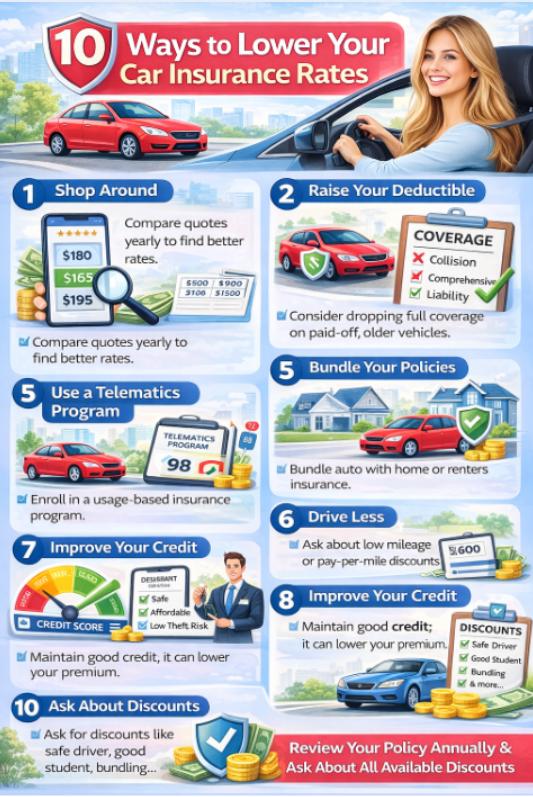
    Car insurance savings checklist for comparing vehicles, discounts, mileage and coverage

    11. Protect your driving record

    At-fault accidents and traffic violations can affect premiums, and the NAIC advises shoppers to compare how insurers apply discounts or surcharges based on driving history.[2] Safer driving therefore has both an immediate safety benefit and a potential long-term insurance benefit.

    Be careful with advice telling drivers simply to “avoid small claims.” Whether an incident should be reported can depend on the policy, the people or property involved, and state requirements. If another person, vehicle, or property is involved, or if you are unsure about reporting obligations, review your policy and contact the appropriate insurer rather than assuming an incident can be handled privately.

    12. Review optional add-ons one by one

    Rental reimbursement, roadside assistance, custom equipment coverage, gap-related protection, and other optional features can be useful, but not every driver needs every add-on. Check whether you already receive similar benefits through a vehicle warranty, auto club, credit card, manufacturer program, or another policy before paying twice for overlapping services.

    Do not remove an add-on merely because it is optional. Decide whether you could comfortably absorb the expense that the coverage is designed to handle. Drivers who travel frequently can compare the cost and benefits of car insurance with roadside assistance.

    What you should not cut just to get a cheaper premium

    The cheapest policy can become extremely expensive after a serious accident if its limits are too low. Before reducing coverage, separate “optional convenience” from “financial protection.”

    • Do not automatically reduce liability limits to the state minimum. Minimum limits may be inadequate for a serious crash.
    • Do not drop lender-required coverage. Financed and leased vehicles commonly have contractual physical-damage requirements.
    • Do not misstate mileage, vehicle use, garaging address, or household drivers. Price savings are not worth creating an underwriting problem.
    • Do not choose a deductible you could not pay. A lower premium is not useful if the deductible makes a valid claim financially unmanageable.
    • Do not compare quotes with different limits and call the cheapest one the winner. Compare equivalent protection first.

    A practical renewal checklist

    1. Pull your current declarations page.
    2. Write down your liability limits, deductibles, and optional coverages.
    3. Confirm drivers, vehicles, garaging address, commute, and estimated mileage.
    4. Ask your current insurer to review all available discounts.
    5. Get at least three comparable quotes.
    6. Compare the total annual premium, not just the monthly payment.
    7. Check complaint/service information and financial strength before switching.
    8. Do not cancel the old policy until the replacement policy is confirmed effective.

    Frequently asked questions

    What is the quickest way to lower car insurance?

    Comparing equivalent quotes from several insurers is usually the fastest first step because it does not require changing your driving record or waiting for long-term factors to improve. After that, review discounts, deductibles, mileage, and optional coverage.

    Does raising my deductible always lower my premium?

    It commonly reduces the cost of coverages that use a deductible, but the amount varies. Ask for the exact premium at multiple deductible levels and compare the annual savings with the additional amount you would have to pay after a claim.

    Should I drop collision and comprehensive on an older car?

    Not automatically. Compare the car’s current value, your deductible, the annual cost of collision and comprehensive, and whether you could afford to repair or replace the vehicle yourself. If the vehicle is financed or leased, your contract may require those coverages.

    Can driving fewer miles lower car insurance?

    It can with some insurers because annual mileage and vehicle use may be rating factors. If your driving has decreased, update the estimate with your insurer and ask whether a low-mileage or usage-based option is available.

    Can telematics make my insurance more expensive?

    It depends on the insurer, program, and state. Some programs are designed primarily around discounts, while others may use driving behavior in a way that can affect the rate more broadly. Ask how the program works before enrolling.

    Does credit affect car insurance rates?

    In many states, insurers may use credit-based insurance information as one rating factor, but the rules vary and some states restrict or prohibit certain uses. Ask your insurer or state insurance department what applies where you live.

    How often should I compare car insurance quotes?

    Renewal is a natural time to compare, and it is also worth checking after a major change such as moving, adding or removing a vehicle, changing commute patterns, or adding a driver.

    Bottom line

    Lowering car insurance rates is not about finding the thinnest policy. The strongest approach is to compare equivalent quotes, remove coverage that no longer makes financial sense, adjust deductibles carefully, update your policy information, and use discounts that match your real situation.

    Start with the changes that do not reduce protection—shopping around, correcting policy information, verifying discounts, and comparing payment options—then evaluate deductibles and optional coverage with the numbers in front of you.

    Compare car insurance options using the same coverage limits and deductibles.

    Enter your ZIP code in the quote tool on this page to compare available options for your location. Availability, pricing, and eligibility vary by insurer, state, and driver profile.

    References

  • Texas Car Insurance

    Texas auto insurance guide

    Texas car insurance is the most common way drivers satisfy the state’s financial-responsibility requirement. A minimum liability policy provides at least $30,000 of bodily injury coverage per person, $60,000 per accident, and $25,000 of property damage coverage.

    Those 30/60/25 limits are only the starting point. Texas also has important rules for personal injury protection and uninsured/underinsured motorist coverage. In addition, drivers may want collision, comprehensive, rental reimbursement, roadside assistance, or higher liability limits depending on their vehicle and finances.

    This guide focuses on the bigger Texas picture: what the state requires, how premiums are determined, how TexasSure works, what to do if insurers turn you down, and how to compare policies without relying on outdated city rankings or promotional rate claims.

    Minimum liability 30 / 60 / 25

    $30,000 per injured person, $60,000 per accident, and $25,000 for property damage.

    PIP Included unless rejected

    Texas insurers must provide PIP unless the named insured rejects it in writing.

    UM/UIM Included unless rejected

    Uninsured and underinsured motorist coverage can also be rejected in writing.

    TexasSure Insurance verification

    The state uses an electronic system to match registered vehicles with insurance records.

    Texas car insurance requirements and coverage
    Texas drivers should compare the state’s minimum requirements with the amount of protection their household and vehicle actually need.
    Legal starting point

    Texas Car Insurance Minimum Requirements

    Texas law requires drivers to show financial responsibility for accidents they cause. Most people satisfy that obligation by purchasing auto liability insurance.

    The minimum liability policy is commonly called 30/60/25 coverage.[1]

    Bodily injury $30,000

    Maximum for bodily injury to one person, subject to the policy terms.

    Bodily injury $60,000

    Maximum total for bodily injury to two or more people in one accident.

    Property damage $25,000

    Maximum for property damage caused in one accident.

    The Texas minimum might not be enough protection for every driver.

    If you cause losses above your liability limits, your insurance policy does not automatically increase to cover the rest. The unpaid amount could become your responsibility.

    Why the $25,000 property damage limit can matter

    Imagine that you cause an accident involving an expensive vehicle and the covered property damage totals $40,000. A minimum policy with a $25,000 property damage limit would not provide $40,000 simply because that is the amount of the loss.

    Therefore, drivers with income, savings, property, or other assets may want to compare higher liability limits rather than selecting the minimum automatically.

    For a deeper discussion of liability, collision, comprehensive, and other policy choices, see our guide to car insurance coverage in Texas.

    Important Texas rules

    PIP and Uninsured Motorist Coverage in Texas

    Texas has two coverage rules that are easy to miss when a guide discusses only the 30/60/25 liability minimum.

    Insurers must provide personal injury protection (PIP) unless the named insured rejects it in writing. Texas law also requires uninsured/underinsured motorist coverage to be provided unless a named insured rejects that coverage in writing.[2]

    PIP

    Personal Injury Protection

    PIP can pay eligible medical expenses and certain lost-income or essential-services benefits after an accident, subject to the policy and Texas law.

    UM/UIM

    Uninsured / Underinsured Motorist

    This coverage can help when an at-fault driver has no insurance or not enough insurance to cover eligible damages.

    Rejecting these coverages should be a deliberate decision.

    The fact that Texas allows a written rejection does not mean the protection has no value. Compare the premium difference with the financial risk you would keep yourself.

    Policy building blocks

    What Coverage Can a Texas Auto Policy Include?

    The legal minimum and a well-rounded insurance policy are not the same thing. Different coverages solve different problems.

    Coverage Texas status What it generally does
    Liability Most common way to meet the state requirement Helps pay eligible injury and property damage claims when you are legally responsible for an accident.
    PIP Provided unless rejected in writing Can pay eligible medical expenses, lost income, and certain related benefits regardless of fault.
    UM/UIM Provided unless rejected in writing Can protect you after an accident with an uninsured or underinsured at-fault driver.
    Collision Optional under state law Can pay for covered damage to your vehicle from a collision, subject to the deductible and policy terms.
    Comprehensive Optional under state law Can cover eligible non-collision losses such as theft, hail, flood, fire, vandalism, or animal damage.
    Rental reimbursement Optional Can help with transportation while your vehicle is being repaired after a covered loss.
    Towing / roadside assistance Optional May help with towing, battery service, lockouts, or other roadside events, depending on the product.

    A lender can also require collision and comprehensive coverage while it has a financial interest in a vehicle. Therefore, a financed or leased car can have requirements beyond the minimum coverage needed simply to drive legally.

    If you are specifically comparing broader policies, our Texas full coverage insurance guide goes deeper into those choices.

    Premium factors

    What Affects Texas Car Insurance Costs?

    There is no single statewide premium that applies to every Texas driver. Insurers evaluate several factors, and the same driver can receive different prices from different companies.

    01

    Driving and claims history

    Accidents, tickets, claims, and other driving history can affect both eligibility and premium.

    02

    Where you keep the vehicle

    Rates can differ between cities and even between ZIP codes because claim patterns, theft, congestion, and other risks differ.

    03

    Vehicle type

    Repair cost, replacement value, theft experience, performance, and other vehicle characteristics can affect the price of physical-damage coverage.

    04

    How much and how you drive

    Annual mileage, commuting, business use, and driving patterns can influence the insurer’s assessment of risk.

    05

    Driver characteristics

    Age and other permitted rating factors can affect pricing. Insurers do not necessarily weigh every factor the same way.

    06

    Credit information

    Some Texas insurers use credit information when setting prices or underwriting. However, a company cannot turn you down based solely on credit.

    07

    Coverage and deductibles

    Higher limits or additional coverage generally cost more. A higher deductible can reduce the premium but increases what you pay after a covered loss.

    08

    Broader claim costs

    Repair inflation, severe accidents, weather losses, and other statewide claim trends can affect insurance costs across many policyholders.

    Texas Department of Insurance identifies driving history, location, mileage, vehicle characteristics, credit, and other personal factors as common inputs. TDI also notes that weather events and higher repair costs affect overall claim costs.[3]

    Averages are not quotes.

    City rankings and statewide averages can be useful for market research, but they do not tell you what a company will charge your household. That is why this guide does not publish an evergreen list of “cheapest Texas cities.”

    Texas-specific considerations

    Insurance Risks Texas Drivers Should Consider

    01

    Uninsured drivers

    TexasSure estimated that 11.87% of Texas drivers were uninsured as of September 2025.[4]

    That is one reason to look carefully at UM/UIM coverage before signing a rejection.

    02

    Hail, floods, hurricanes, and storms

    Texas experiences hailstorms, hurricanes, floods, freezes, tornadoes, wildfires, and major thunderstorms. Those events contribute to insurance claim costs.[3]

    Liability alone generally does not protect your own car from these types of physical damage.

    03

    Driving into Mexico

    Texas drivers who cross the border need to understand an important limitation: Mexico does not recognize a standard U.S. auto insurance policy as satisfying Mexican liability requirements.[5]

    TDI recommends buying Mexican liability insurance when driving in Mexico.

    Insurance verification

    What Is TexasSure?

    TexasSure is not an insurance plan. It is the state’s electronic insurance-verification system.

    The database helps Texas agencies identify whether registered vehicles are matched to required insurance coverage. TxDMV describes it as a joint project involving the departments of motor vehicles, insurance, public safety, and information resources.[4]

    It verifies

    Whether vehicle registration information can be matched with insurance information reported through the system.

    It does not sell

    TexasSure is not a low-cost insurance program, teen policy, or alternative to buying liability coverage.

    Shopping method

    How to Compare Texas Car Insurance Quotes

    Comparing only the monthly premium can produce a misleading result. One quote can look cheaper simply because it provides less coverage.

    1

    Choose your liability limits first

    Use the same liability limits for every quote so you are comparing equivalent protection.

    2

    Keep PIP and UM/UIM choices consistent

    Do not compare a quote that includes these coverages with another quote that rejects or reduces them without accounting for the difference.

    3

    Match collision and comprehensive deductibles

    A $1,000 deductible quote should not be compared directly with a $250 or $500 deductible quote as if the policies were identical.

    4

    Use the same drivers and vehicles

    Household drivers, mileage, vehicle use, garaging location, and other information should remain consistent.

    5

    Compare exclusions and optional coverage

    Look beyond the declarations page price. Check rental reimbursement, roadside assistance, excluded drivers, endorsements, and other policy terms.

    6

    Check the company

    TDI recommends checking licensing and complaint information, not just selecting the cheapest quote.

    TDI advises consumers to get prices from several companies and compare the same types and amounts of coverage. It also warns drivers not to cancel an existing policy until replacement coverage is in place.[6]

    For a page focused specifically on switching and shopping, see our guide to comparing Texas car insurance quotes.

    Controlling your premium

    Ways to Lower Texas Car Insurance Costs

    Shop periodically

    Companies price risk differently. Another insurer may offer a better combination of price and coverage.

    Ask about discounts

    Discounts can include good-driver, low-mileage, multi-car, anti-theft, good-student, paperless, and bundling options. Availability varies by insurer.

    Choose a deductible you can afford

    A higher deductible can reduce the premium. However, make sure you could actually pay that amount after a claim.

    Review vehicle coverage as the car ages

    Compare the value of an older paid-off vehicle with what you pay for collision or other optional protection. Avoid arbitrary dollar-value rules.

    Update your mileage

    If you drive significantly less than before, tell the insurer. Some companies offer low-mileage, pay-per-mile, or usage-based options.

    Keep your record as clean as possible

    Accidents, claims, and traffic violations can make insurance more expensive or reduce the number of companies willing to offer a policy.

    Texas Department of Insurance recommends shopping around, checking discounts, reviewing deductibles and coverage, and keeping insurers informed when driving habits change.[7]

    Drivers looking to reduce premiums can also compare cheap Texas car insurance options while keeping the coverage they actually need.

    Hard-to-insure drivers

    What If You Cannot Find Texas Auto Liability Insurance?

    Some drivers may have difficulty finding liability insurance in the voluntary market because of their driving record or other underwriting factors.

    Texas has a safety-net option called the Texas Automobile Insurance Plan Association (TAIPA). TDI states that a driver can apply through TAIPA after being turned down for auto liability coverage by at least two insurance companies during the previous 60 days.[8]

    Eligibility Two liability rejections

    The rejections must meet TAIPA’s applicable requirements, including the 60-day timeframe described by TDI.

    Core coverage 30 / 60 / 25 liability

    TAIPA can provide the minimum liability limits used to satisfy Texas financial-responsibility requirements.

    Additional coverage PIP and UM/UIM

    TDI states that TAIPA also offers uninsured/underinsured motorist coverage and $2,500 of personal injury protection.

    TAIPA is not automatically the cheapest choice. It is a residual-market option for eligible drivers who cannot obtain liability insurance through the normal market.

    If your issue involves a serious driving record or financial-responsibility filing, our separate Texas SR-22 insurance guide explains that process.

    Cars, pickups, and financing

    Texas Insurance Considerations for Different Vehicles

    Financed or leased vehicles

    Your lender or lessor may require collision and comprehensive coverage even though Texas law does not generally require those coverages for every vehicle.

    Older paid-off vehicles

    Review the cost of optional physical-damage coverage against the vehicle’s value and the amount you could afford to replace yourself.

    Pickup trucks

    Personal-use pickups can generally be insured through personal auto coverage, while business use can change the insurance analysis.

    See our Texas pickup truck insurance guide for the truck-specific details.

    Before you buy

    Texas Car Insurance Checklist

    • Confirm that liability limits are at least 30/60/25.
    • Decide whether the state minimum provides enough liability protection for your finances.
    • Review PIP before signing a written rejection.
    • Review UM/UIM before signing a written rejection.
    • Check lender requirements on financed or leased vehicles.
    • Choose collision and comprehensive deductibles you could afford after a claim.
    • Use identical limits and deductibles when comparing quotes.
    • Ask about discounts you actually qualify for.
    • Check the insurer’s license and complaint information.
    • Do not cancel existing coverage until the replacement policy is active.
    • If you drive into Mexico, arrange appropriate Mexican liability coverage.
    • If voluntary insurers turn you down, ask whether you qualify for TAIPA.
    Frequently asked questions

    Texas Car Insurance FAQ

    What is the minimum car insurance required in Texas?

    Texas minimum liability coverage is commonly described as 30/60/25: $30,000 of bodily injury liability per person, up to $60,000 per accident, and $25,000 of property damage liability per accident.

    Is liability insurance enough in Texas?

    It may satisfy the basic financial-responsibility requirement, but it does not automatically protect your own vehicle from collision, theft, hail, flood, or other physical damage. Whether you need additional coverage depends on your vehicle, finances, lender requirements, and risk tolerance.

    Is PIP required in Texas?

    Texas insurers must provide personal injury protection unless the named insured rejects it in writing. Therefore, it is more accurate to describe PIP as automatically provided unless rejected rather than simply calling it optional.

    Is uninsured motorist coverage required in Texas?

    Texas insurers must provide uninsured/underinsured motorist coverage unless a named insured rejects it in writing. Drivers should compare the cost and protection before signing a rejection.

    Does Texas require full coverage?

    No state law generally requires every driver to carry what consumers call “full coverage.” However, a lender or lessor can require collision and comprehensive coverage on a financed or leased vehicle.

    What determines the price of Texas car insurance?

    Common factors include driving and claims history, where the vehicle is kept, mileage, vehicle type, coverage choices, deductibles, driver characteristics, and credit information when permitted. Broader repair and weather claim costs can also influence insurer rates.

    Can Texas insurers use my credit?

    Some companies use credit information as one factor in underwriting or pricing. Texas rules do not allow an insurer to turn you down based solely on credit information.

    What is TexasSure?

    TexasSure is an electronic insurance-verification system used to match Texas vehicle records with insurance information. It is not an insurance company or low-cost insurance program.

    What happens if no company will insure me?

    If at least two companies have turned you down for auto liability coverage within the applicable 60-day period, you may qualify to apply through the Texas Automobile Insurance Plan Association.

    Does my Texas auto policy cover me in Mexico?

    Do not assume it does. Texas Department of Insurance states that Mexico does not recognize U.S. auto policies as satisfying Mexican insurance requirements and recommends buying Mexican liability insurance when driving there.

    How can I compare Texas car insurance companies fairly?

    Use the same liability limits, deductibles, drivers, vehicles, mileage, PIP and UM/UIM choices, and optional coverages on every quote. Then compare policy terms, insurer licensing, complaint information, and price.

    Should I choose the cheapest Texas car insurance quote?

    Not automatically. A cheaper policy can have lower limits, higher deductibles, fewer optional coverages, or different exclusions. Compare what each policy actually provides before choosing based on price.

    Bottom line

    Start With Texas Requirements, Then Build Coverage Around Your Risk

    Texas car insurance starts with 30/60/25 liability coverage, but the state minimum is only one part of the decision.

    Review PIP and UM/UIM carefully before rejecting them. Then consider your own vehicle, savings, assets, lender requirements, driving habits, weather exposure, and ability to absorb a large claim.

    Finally, compare policies using the same limits and deductibles. That gives you a much more useful comparison than choosing an insurer simply because one advertisement or average-rate table shows a lower number.

    Compare equivalent policies

    Ready to Compare Texas Car Insurance?

    Keep the coverage limits, deductibles, drivers, and vehicles consistent across quotes so you can see which policy offers the better combination of price and protection.

    Compare Texas Car Insurance Options

    References

    1. Texas Department of Insurance — Auto Insurance Glossary and 30/60/25 Liability Limits
    2. Texas Constitution and Statutes — Insurance Code Chapter 1952, PIP and UM/UIM
    3. Texas Department of Insurance — How Auto Insurance Costs Are Calculated
    4. Texas Department of Motor Vehicles — TexasSure Insurance Verification
    5. Texas Department of Insurance — Auto Insurance FAQ, Including Driving in Mexico
    6. Texas Department of Insurance — How to Shop Smart for Auto Insurance
    7. Texas Department of Insurance — Lower Your Car Insurance Costs
    8. Texas Department of Insurance — Texas Automobile Insurance Plan Association (TAIPA)