Florida car insurance can be more complicated than policies in many other states because drivers face unique challenges, including severe weather risks, high repair costs, heavy traffic areas, and a large number of uninsured motorists.
Choosing the right policy requires more than finding the lowest premium. Florida drivers should compare coverage options, understand state requirements, and select limits that provide appropriate financial protection.
Florida Car Insurance Requirements
Florida has unique auto insurance requirements compared with many other states.[1] Drivers must maintain minimum coverage to legally operate a registered vehicle, but these minimum limits may not provide enough protection after a serious accident.
Personal Injury Protection (PIP)
Florida requires drivers to carry Personal Injury Protection (PIP), which helps cover certain medical expenses and lost wages after an accident regardless of who caused the crash.
Property Damage Liability
Property Damage Liability coverage helps pay for damage you cause to another person’s vehicle or property while driving.
Additional Protection
Many drivers choose higher limits and additional car insurance coverage options such as collision, comprehensive, and uninsured motorist protection to address risks that Florida’s minimum requirements do not fully cover.
How Much Does Car Insurance Cost in Florida?
Florida auto insurance rates vary significantly depending on personal factors. The price one driver receives may be very different from another driver’s quote, even in the same city.
Factor
How It Can Affect Rates
Driving Record
Accidents, violations, and claims history can increase premiums.
Location
Urban areas with more traffic and claims may have different pricing.
Vehicle Type
Repair costs, vehicle value, and safety features can influence premiums.
Coverage Choices
Higher limits and additional protection generally increase premiums but provide broader protection.
Best Car Insurance Companies in Florida
The right choice among Florida car insurance companies depends on your driving profile, coverage needs, budget, and preferences. Some drivers prioritize affordable premiums, while others focus on customer service, discounts, or coverage flexibility.
GEICO
Often considered by drivers looking for competitive pricing and convenient online tools.
State Farm
Known for its agent network and multiple insurance discount opportunities.
Progressive
Popular among drivers looking for flexible options and usage-based programs.
Florida Car Insurance Coverage Options
Minimum insurance requirements may allow drivers to legally operate a vehicle, but many consumers choose additional protection depending on their vehicle value and financial situation.
Coverage
Purpose
Collision Coverage
Helps pay for damage to your vehicle after a covered accident.
Comprehensive Coverage
Protects against non-collision losses such as theft, fire, storms, and certain weather events.
Uninsured Motorist Coverage
Provides protection when another driver does not have enough insurance to cover your losses.
Roadside Assistance
Provides emergency services such as towing and roadside help.
Why Florida Car Insurance Rates Can Be Higher
Several factors contribute to Florida insurance pricing. Severe storms, hurricanes, vehicle repair costs, population growth, and claim frequency can all influence premiums.[3]
Severe Weather
Florida drivers may face risks from hurricanes, flooding, storms, and other weather-related events.
Uninsured Drivers
A higher number of uninsured motorists can increase financial risks for insured drivers.
Repair Costs
Higher vehicle repair expenses can affect insurance pricing across the market.
How Florida Drivers Can Save Money on Car Insurance
Compare multiple insurance companies before choosing a policy.
Ask insurers about available discounts.
Maintain a clean driving record whenever possible.
Review deductibles and coverage limits regularly.
Remove unnecessary coverage when vehicle value decreases.
Florida SR-22 Insurance Requirements
Some Florida drivers who need an SR-22 may face the requirement after certain violations or license-related issues. An SR-22 is not a separate insurance policy but a certificate showing that required insurance coverage is active.
Florida Insurance Market and Citizens Insurance
Florida’s insurance market has changed significantly in recent years.[4] Many consumers encounter Citizens Property Insurance when comparing Florida property coverage because of challenges affecting the state’s homeowners insurance market, but auto insurance decisions require evaluating vehicle coverage, pricing, and personal needs separately.
Florida Car Insurance FAQ
What car insurance is required in Florida?
Florida requires Personal Injury Protection (PIP) and Property Damage Liability coverage for registered vehicles. Many drivers choose additional coverage for broader protection.
Is Florida car insurance expensive?
Florida insurance costs can be higher than many states because of weather risks, repair costs, traffic conditions, and insurance market factors.
Do I need full coverage car insurance in Florida?
Full coverage is not required by Florida law, but lenders often require collision and comprehensive coverage for financed vehicles.
How can I lower my Florida car insurance costs?
Drivers can reduce costs by comparing insurers, maintaining a good driving record, adjusting coverage appropriately, and taking advantage of available discounts.
Compare Florida Car Insurance Options
The right Florida car insurance policy depends on your vehicle, driving history, location, and financial needs. Understanding requirements and comparing coverage options can help you make a more informed decision.
Insurance Information Institute. Auto insurance coverage explanations, claims information, and consumer education resources.
Insurance Information Institute
↩
National Association of Insurance Commissioners. Consumer information about auto insurance markets, coverage, and insurance regulation.
NAIC Auto Insurance Consumer Resources
↩
Car insurance discounts for safe drivers can help responsible motorists reduce their insurance costs while maintaining the protection they need. Insurance companies often reward lower-risk driving behaviors through programs based on driving history, claims records, and other eligibility factors.
A clean driving record is one of the factors many insurers consider when evaluating auto insurance premiums. Drivers with fewer accidents, violations, and claims may have access to different savings opportunities depending on their insurer, state, and personal circumstances.
Understanding how safe driver discounts work can help you compare policies, identify potential savings opportunities, and choose coverage that balances affordability with financial protection.
Safe driving habits may help eligible drivers qualify for auto insurance savings opportunities.
Discount guide
What Is a Safe Driver Discount?
A safe driver discount is a potential insurance savings opportunity offered to drivers who meet certain criteria related to responsible driving behavior. Insurance companies may evaluate factors such as accident history, traffic violations, years of driving experience, and claims activity when determining eligibility.
Requirements vary by insurer and location. Some companies may offer discounts after a specific period without accidents or violations, while others may use technology-based programs that evaluate driving habits.
Clean Driving Record
Drivers with fewer accidents and traffic violations may be considered lower risk and may qualify for available discounts.
Responsible Driving Habits
Programs that evaluate behaviors such as braking, mileage, and driving patterns may provide additional savings opportunities for eligible drivers.
Claims-Free History
Drivers with fewer qualifying claims may be considered lower risk and may have access to certain insurance savings opportunities.
Common savings
Types of Car Insurance Discounts for Safe Drivers
Safe drivers may qualify for different types of discounts depending on the insurance company and their personal profile. These programs are designed to recognize behaviors associated with lower insurance risk.
Accident-Free Discount
Some insurers provide discounts to drivers who maintain a period without at-fault accidents or qualifying claims.
Defensive Driving Discount
Completing an approved defensive driving course may help eligible drivers receive a discount in certain situations.
Usage-Based Insurance Programs
Some insurers use mobile apps or devices to evaluate driving habits and offer personalized pricing opportunities.
Low Mileage Discounts
Drivers who use their vehicles less frequently may qualify for savings with certain insurers.
Drivers can also explore related savings opportunities such as student car insurance discounts when comparing available options.
Eligibility factors
How Insurance Companies Determine Safe Driver Discounts
Insurance companies use different criteria when deciding whether a driver qualifies for safe driving discounts. While each insurer has its own requirements, many programs consider driving behavior, claims history, and other risk-related factors.
Driving Record
A history with fewer accidents, violations, and insurance claims may indicate lower risk and can improve eligibility for certain discounts.
Years of Driving Experience
Some insurers consider driving experience when evaluating risk because drivers with more time behind the wheel may have different risk profiles.
Claims History
A history with fewer qualifying claims may help drivers access certain savings opportunities depending on the insurer.
Driving Monitoring Programs
Usage-based insurance programs may evaluate driving habits through mobile applications or devices, depending on the insurer and state availability.
The National Association of Insurance Commissioners explains that insurers consider multiple factors when determining auto insurance premiums, including driving history and individual risk characteristics. [1]
Potential savings
How Much Can Safe Drivers Save on Car Insurance?
The amount a safe driver can save depends on several factors, including the insurance company, state regulations, driving history, vehicle type, and existing policy details. There is no universal discount amount that applies to every driver.
Discount availability and savings amounts vary by insurer, state, driving profile, and policy details. Drivers should confirm eligibility requirements directly with their insurance provider.
Drivers with strong records may benefit from combining safe driving discounts with other eligible savings opportunities. Some insurers allow customers to combine multiple discounts depending on their situation and policy conditions.
Important savings note
A lower premium should not be the only factor when choosing auto insurance. Drivers should also review coverage limits, deductibles, exclusions, and customer service options to make sure their policy provides appropriate protection.
Drivers interested in reducing their overall insurance costs can also explore options for affordable insurance for used vehicles and other coverage solutions.
Insurance providers
Examples of Insurance Companies With Safe Driver Programs
Many major insurance companies provide discounts or programs designed to reward responsible driving. Availability and eligibility requirements vary by state, policy type, and individual driver profile.
GEICO
GEICO offers different discount opportunities and tools that may help eligible drivers reduce insurance costs.
Progressive
Progressive provides programs that evaluate different driver profiles and may offer savings opportunities for qualifying customers.
State Farm
State Farm provides auto insurance discounts and programs designed for drivers who meet specific eligibility requirements.
USAA
USAA offers auto insurance options and discounts for eligible military members, veterans, and their families.
Discount structures vary from one carrier to another, so comparing auto insurance companies and their available discounts can reveal differences in eligibility rules, savings opportunities, and how those discounts affect the final premium.
For newer motorists, the savings available through Progressive discounts for new drivers may depend on driving history, policy details, and participation in qualifying programs, making the final quoted premium more important than any advertised discount alone.
Maximize savings
Tips to Qualify for More Auto Insurance Discounts
Maintain a Clean Record
Avoiding accidents and traffic violations can help maintain a favorable insurance profile over time.
Review Your Policy Regularly
Insurance needs change over time, so reviewing your coverage can help identify available savings opportunities.
Ask About Available Programs
Contacting your insurer about available discounts can help ensure you are receiving all eligible savings.
Common questions
Frequently Asked Questions About Safe Driver Discounts
What is considered a safe driver for insurance discounts?
A safe driver is generally someone who demonstrates responsible driving habits, such as maintaining a clean record with fewer accidents, violations, and qualifying claims. Each insurance company uses its own eligibility requirements.
How long does a clean driving record affect insurance rates?
The impact of a clean driving record depends on the insurer, state regulations, and individual policy factors. Maintaining responsible driving habits over time may help drivers access better insurance options.
Can new drivers qualify for safe driver discounts?
New drivers may have less driving history available for evaluation, but they may qualify for other discounts depending on factors such as education, training, vehicle features, or participation in approved driving programs.
Do safe driver discounts automatically apply?
Not always. Drivers may need to meet specific requirements or contact their insurance company to confirm available discounts and eligibility.
Can I combine safe driver discounts with other savings?
Many insurers allow customers to combine different discounts, although availability depends on the company, state regulations, and policy conditions.
Can a safe driver discount be removed?
Yes. A discount may change or no longer apply if a driver no longer meets the insurer’s eligibility requirements, such as after certain violations, accidents, or qualifying claims.
Understand your options
Compare Car Insurance Discounts for Safe Drivers
Safe driving habits can help consumers access potential insurance savings, but the right policy should also provide appropriate coverage and protection. Comparing insurers, understanding discount requirements, and reviewing policy details can help drivers make informed decisions. [2]
Reviewing available coverage choices, discounts, and policy terms before selecting an auto insurance plan can help consumers choose protection that fits their needs. [3]
Drivers who maintain responsible habits should regularly review their insurance options to make sure they are receiving available discounts while keeping the coverage they need.
Finding cheap car insurance in Texas requires more than searching for the lowest premium. Drivers should consider affordability, coverage protection, policy limits, and the features that best match their personal situation.
Auto insurance rates in Texas vary depending on several factors, including driving history, vehicle type, location, annual mileage, selected coverage limits, and available discounts. Comparing different options can help drivers find affordable coverage while maintaining appropriate financial protection.
Whether you are purchasing insurance for a new vehicle, reviewing your current policy, or trying to reduce your expenses, understanding Texas auto insurance requirements and coverage options can help you make a more informed decision.
Comparing auto insurance options can help Texas drivers find affordable coverage that fits their needs.
Texas auto insurance guide
Understanding Cheap Car Insurance in Texas
The cost of car insurance depends on more than the insurance company alone. Insurers consider individual risk factors, coverage selections, vehicle information, and location when determining premiums.
Affordable Does Not Always Mean Minimum Coverage
The cheapest policy may not provide enough financial protection after a serious accident. Drivers should compare prices while reviewing liability limits, deductibles, and optional coverage.
Coverage Should Match Your Vehicle
Newer, financed, or higher-value vehicles may require broader protection, including collision and comprehensive coverage depending on lender requirements.
Compare Before Choosing
Pricing and protection can vary between insurers, so comparing several policies on similar terms makes it easier to see whether differences come from the company, the coverage selected, or the limits offered.
When selecting a policy, Texas car insurance requirements and coverage options should be considered alongside the vehicle’s value, financing status, deductibles, and the level of financial protection you want to keep.
Cost factors
How Much Does Cheap Car Insurance Cost in Texas?
Car insurance costs in Texas vary from driver to driver. Two people with the same vehicle may receive different quotes because insurers evaluate personal risk factors and coverage preferences.
Factor
How It Can Affect Insurance Costs
Driving Record
Accidents, claims, and traffic violations may increase premiums, while responsible driving habits may help drivers qualify for better rates.
Vehicle Type
Vehicle value, repair costs, safety features, and theft risk can influence insurance pricing.
Coverage Selection
Higher limits and additional protections may increase premiums but can provide stronger financial protection.
Location
Rates can vary between Texas cities and regions because of traffic conditions, claims history, and local risks.
The Texas Department of Insurance explains that auto insurance premiums are affected by factors such as coverage choices, deductibles, and individual circumstances. [1]
Provider comparison
Affordable Car Insurance Options Texas Drivers Can Compare
Finding affordable car insurance in Texas usually requires comparing several providers because insurance rates are based on individual risk factors. A company that offers a competitive price for one driver may not provide the same value for another driver with a different vehicle, location, or driving history.
When comparing insurers, drivers should review more than the advertised premium. Coverage options, customer service, available discounts, claims experience, and financial protection are all important factors when choosing a policy.
GEICO
GEICO is often considered by drivers looking for competitive pricing, online tools, and a variety of available savings opportunities.
State Farm
State Farm may appeal to drivers who value a large agent network and access to multiple insurance products.
Progressive
Progressive offers different coverage programs and tools that may fit drivers with different insurance profiles.
USAA
USAA provides auto insurance options for eligible military members, veterans, and their families.
Drivers considering a change in insurers can use affordable Texas car insurance quotes to compare pricing and coverage differences before deciding which policy fits their needs.
Texas requirements
Texas Minimum Car Insurance Requirements
Texas requires drivers to show financial responsibility for accidents they cause. Most drivers satisfy this requirement by purchasing liability insurance. [1]
The minimum liability coverage commonly required in Texas is known as 30/60/25 coverage:
Coverage Type
Minimum Requirement
Bodily Injury Liability
$30,000 per person injured in an accident and up to $60,000 total for injuries in one accident.
Property Damage Liability
$25,000 for damage caused to another person’s property in an accident.
Important coverage note
Minimum liability insurance helps drivers meet legal requirements, but it does not usually pay to repair their own vehicle after an accident. Drivers with newer vehicles, financed cars, or significant assets may consider additional protection.
The Texas Department of Insurance explains that drivers should consider their coverage needs, deductibles, and financial situation when selecting an auto insurance policy. [1]
Coverage choices
Minimum Coverage vs Full Coverage Car Insurance in Texas
Drivers searching for cheap car insurance in Texas often compare minimum liability coverage with broader protection options. The right choice depends on the value of the vehicle, financial circumstances, and personal preferences.
Minimum Liability Coverage
Provides required protection for damages or injuries caused to others but generally does not cover repairs to your own vehicle.
Full Coverage Insurance
Usually combines liability, collision, and comprehensive coverage to provide broader protection for eligible losses.
Higher Coverage Limits
Higher limits may provide additional financial protection if accident-related costs exceed minimum policy limits.
Cheap Car Insurance Considerations for Different Texas Drivers
Insurance companies evaluate each driver differently. Understanding how personal circumstances affect rates can help Texas drivers search more effectively for affordable coverage.
Young Drivers
New and younger drivers often face higher premiums because insurers consider driving experience when evaluating risk.
Drivers With Clean Records
A history of responsible driving may help drivers qualify for more competitive insurance rates.
Drivers With Previous Claims
Drivers with accidents or claims may need to compare more providers to find suitable coverage options.
Saving strategies
Ways Texas Drivers Can Save on Car Insurance
Drivers looking for cheap car insurance in Texas can often reduce costs by comparing providers, maintaining responsible driving habits, reviewing available discounts, and selecting coverage that matches their actual needs.
Insurance companies evaluate risk differently, so the same driver may receive different prices from different insurers. Shopping around and comparing policies can help identify better value without automatically choosing the lowest level of protection. [2]
Compare Multiple Quotes
Requesting quotes from different insurers allows drivers to compare pricing, coverage options, deductibles, and policy features.
Ask About Discounts
Eligible drivers may qualify for savings opportunities related to safe driving, multiple policies, vehicle safety features, low mileage, or other factors.
Review Your Coverage Regularly
Life changes, vehicle values, and driving habits can affect whether your current policy still provides the right balance between cost and protection.
Drivers can review additional insurance savings strategies and compare available options before changing their policy.
Shopping guide
How to Compare Cheap Car Insurance Quotes in Texas
A low premium is only one part of choosing auto insurance. Texas drivers should compare policies by looking at coverage limits, deductibles, exclusions, optional protections, and the insurer’s reputation for handling claims.
What to Compare
Why It Matters
Coverage Limits
Higher limits may provide additional financial protection if accident costs exceed minimum requirements.
Deductibles
The deductible affects how much a driver pays out of pocket after certain covered losses.
Discount Opportunities
Available discounts may reduce premiums depending on eligibility requirements.
Policy Features
Additional protections may provide useful benefits depending on the driver’s circumstances.
The Insurance Information Institute recommends understanding coverage options and comparing insurance policies before purchasing auto insurance. [2]
Common questions
Frequently Asked Questions About Cheap Car Insurance in Texas
What is the cheapest car insurance coverage in Texas?
Minimum liability coverage is generally less expensive because it provides fewer protections than broader policies. However, drivers should consider whether minimum coverage provides enough financial protection for their situation.
How can I lower my car insurance costs in Texas?
Drivers can compare multiple providers, maintain a clean driving record, review discounts, and adjust coverage options based on their vehicle and financial needs.
Is Texas minimum insurance enough?
Minimum liability coverage meets legal requirements, but it may not cover damage to your own vehicle or provide enough protection after a serious accident.
Does where I live in Texas affect my insurance rate?
Yes. Insurance companies may consider location-related factors such as traffic conditions, claims history, and local risks when calculating premiums.
Should I buy full coverage car insurance in Texas?
Drivers with newer vehicles, financed cars, or greater financial assets may consider broader coverage options such as collision and comprehensive insurance.
Find suitable protection
Compare Affordable Car Insurance Options in Texas
Finding cheap car insurance in Texas requires balancing affordability with appropriate protection. Comparing providers, reviewing coverage limits, and understanding available options can help drivers make more informed decisions. [3]
Whether you need basic liability coverage or broader protection for a newer vehicle, comparing your options can help you find a policy that fits your budget and coverage needs.
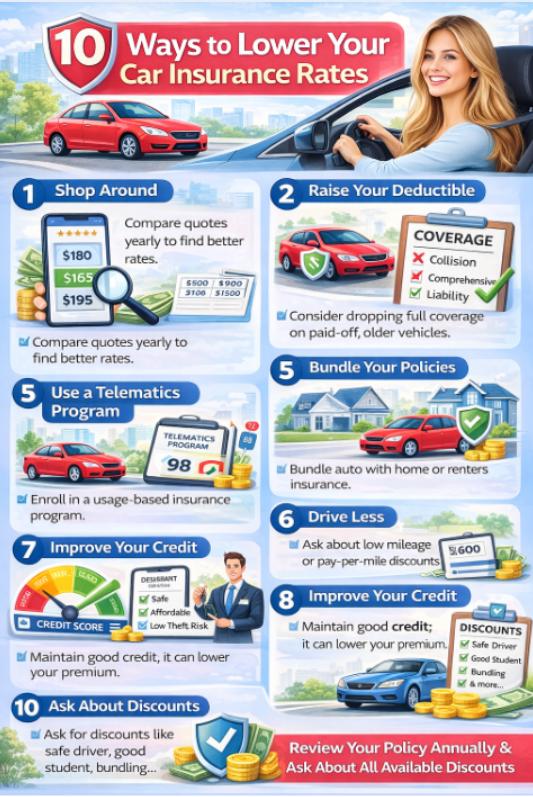
Car insurance rates can change even when your driving habits do not. The good news is that several parts of your premium are within your control: the insurer you choose, your deductibles, optional coverages, annual mileage, discounts, vehicle choice, and—where state law allows—credit-based insurance information.
The goal is not to strip away protection just to make the price look cheaper. A better strategy is to remove waste, compare equivalent policies, and make changes that fit your actual finances and driving habits.
Quick takeaways
Compare quotes using the same liability limits, deductibles, and optional coverages.
Raise deductibles only if you could comfortably pay the higher amount after a covered claim.
Review collision and comprehensive coverage on older, lower-value vehicles.
Ask your insurer to review every discount for which you may qualify.
Update mileage, drivers, garaging address, and vehicle use when your circumstances change.
Do not reduce liability limits simply to reach the lowest possible premium.
The fastest ways to lower car insurance rates
Strategy
Potential impact
Main trade-off
Compare multiple insurers
Often one of the highest-impact steps
Requires comparing equivalent policies
Increase deductibles
Can reduce collision/comprehensive cost
More money out of pocket after a covered claim
Remove unnecessary optional coverage
Can materially reduce premiums on some older cars
You accept more repair/replacement risk
Use discounts and bundling
Varies widely by insurer
A bundle is not automatically the cheapest total package
Report lower mileage or changed vehicle use
Can help when your driving has meaningfully decreased
Savings depend on carrier and state
Try usage-based insurance
Can reward lower-risk driving
Some programs use driving data and may affect pricing differently
1. Compare quotes from several insurers
Shopping around is usually the best place to start because insurers do not price the same driver in exactly the same way. Their rating models, discounts, underwriting preferences, and claims experience differ. A carrier that was competitive at your last renewal may not remain competitive at the next one.
For a fair comparison, keep liability limits, deductibles, uninsured/underinsured motorist protection, medical-related coverages, collision, comprehensive, rental reimbursement, and roadside assistance as similar as possible. Keeping the same car insurance coverage options across every quote helps prevent a lower premium from looking more competitive simply because important protections were reduced or removed.
The Insurance Information Institute recommends getting at least three price quotes and checking more than price alone, including the insurer’s financial condition and service reputation.[5]
2. Increase your deductible—but calculate the break-even point
A higher deductible generally means you accept more of the cost of a covered loss, which can lower the premium for coverages that carry a deductible. But “raise the deductible” is incomplete advice unless you know whether the savings justify the added risk.
Simple deductible test
Break-even period = increase in deductible ÷ annual premium savings
Example: if moving from a $500 deductible to $1,000 adds $500 of potential out-of-pocket cost and saves $125 per year, the break-even period is four years. That does not automatically make the higher deductible good or bad—it simply shows the trade-off clearly.
Only choose a deductible you could reasonably pay on short notice. If an extra $500 or $1,000 after a claim would create a serious financial problem, the lower premium may not be worth the exposure. Consumer guidance from the NAIC and Triple-I likewise emphasizes balancing premium savings against the amount you would need to pay after a claim.[3][4]
3. Review collision and comprehensive coverage on an older car
Collision and comprehensive can be valuable, but the economics change as a vehicle loses value. If you own the car outright, compare what you pay for these coverages with the vehicle’s current value, your deductible, and the amount you could afford to absorb yourself.
Do not drop physical-damage coverage just because a vehicle is “old.” A 10-year-old vehicle can still be worth enough that replacing it would be difficult. Instead, estimate the car’s actual cash value, subtract the deductible, and ask whether the remaining potential payout is meaningful relative to the annual premium.
If the car is financed or leased, the lender or leasing company may require collision and comprehensive coverage. For an older paid-off vehicle, the cost of insuring a used car should be weighed against its current value, deductible, and the amount you could realistically receive after a covered loss.
4. Check every available discount
Discount menus differ substantially by insurer and state, so do not assume the discounts shown on one company’s website will exist—or be equally valuable—at another company. Ask for a policy review and verify which discounts are already applied.
Driver-related discounts may include:
Accident-free or safe-driver
Good student
Student away at school
Approved defensive-driving course
Low-mileage eligibility
Policy-related discounts may include:
Multi-vehicle
Home/auto or renters/auto bundling
Automatic payments
Paperless documents
Paid-in-full or payment-plan savings
Students should compare the total policy price, not just the advertised discount percentage, because car insurance costs for students can still vary widely based on coverage, vehicle choice, driving history, and the insurer applying those discounts.
5. Bundle only after comparing the total cost
Bundling auto with homeowners, renters, or another policy can reduce the combined premium, but the word “discount” does not guarantee the lowest total price. One insurer may offer a strong auto rate and a weak home rate, while another does the opposite.
Compare the annual total of all policies you need. If separate insurers produce a lower combined cost for comparable protection, a bundle may not be the best deal.
6. Update your annual mileage and vehicle use
If your commute has changed, you work from home more often, you retired, you started using public transportation, or a vehicle became a secondary car, tell your insurer. Mileage and vehicle use are rating factors for many insurers, and outdated information can leave your policy priced for driving habits you no longer have.[3]
Give an honest estimate. Understating mileage or misclassifying how a vehicle is used can create underwriting or claim problems later.
7. Consider usage-based or telematics insurance carefully
Usage-based insurance can use a smartphone app, connected vehicle, or device to measure factors such as mileage, time of day, acceleration, braking, and other driving patterns. The NAIC notes that some insurers use this information when determining premiums.[3]
These programs may be attractive to low-mileage drivers and people with consistently smooth driving habits, but they are not automatically a discount for everyone. Before enrolling, ask:
Which driving behaviors are measured?
Can the program increase my rate, or can it only reduce it?
How long is the data collected?
Can I leave the program later?
How is driving data stored, used, and shared?
8. Keep your policy information accurate after life changes
Insurance pricing depends on more than accidents. Moving, changing jobs, changing commute length, adding or removing a driver, buying a different vehicle, or changing where the car is garaged can affect your premium. Review your policy at renewal and whenever a major household or vehicle change occurs.
Do not remove a household driver just to lower the price unless the insurer confirms that the person can properly be removed or excluded under the policy and applicable state rules.
9. Improve credit-related factors where state law allows them
In many states, insurers may use a credit-based insurance score as one factor in underwriting or pricing. A credit-based insurance score is not the same thing as a regular consumer credit score. The NAIC explains that these insurance scores are based on information from a consumer’s credit history and are used only where legally permitted.[1]
If credit-based information can affect your rate, focus on accurate credit reports, on-time payments, and lower revolving balances over time. If a report contains an error, dispute the error with the appropriate credit bureau. Because state restrictions vary, ask your insurer or state insurance department whether and how credit information may be used where you live.
10. Compare insurance costs before buying your next vehicle
The purchase price of a car is only part of its ownership cost. Insurers may consider repair costs, replacement value, theft experience, safety characteristics, and other vehicle-specific data when setting rates. The NAIC consumer guidance specifically identifies vehicle type, repair or replacement cost, and certain features as possible rating factors.[3]
Before signing for a vehicle, request an insurance quote for the exact year, make, model, and trim. Two cars with similar sticker prices can produce very different premiums, and arranging insurance coverage for a new car before the purchase is finalized can help you compare the real ownership cost before committing to the vehicle.
11. Protect your driving record
At-fault accidents and traffic violations can affect premiums, and the NAIC advises shoppers to compare how insurers apply discounts or surcharges based on driving history.[2] Safer driving therefore has both an immediate safety benefit and a potential long-term insurance benefit.
Be careful with advice telling drivers simply to “avoid small claims.” Whether an incident should be reported can depend on the policy, the people or property involved, and state requirements. If another person, vehicle, or property is involved, or if you are unsure about reporting obligations, review your policy and contact the appropriate insurer rather than assuming an incident can be handled privately.
12. Review optional add-ons one by one
Rental reimbursement, roadside assistance, custom equipment coverage, gap-related protection, and other optional features can be useful, but not every driver needs every add-on. Check whether you already receive similar benefits through a vehicle warranty, auto club, credit card, manufacturer program, or another policy before paying twice for overlapping services.
Do not remove an add-on merely because it is optional. Decide whether you could comfortably absorb the expense that the coverage is designed to handle. Drivers who travel frequently can compare the cost and benefits of car insurance with roadside assistance.
What you should not cut just to get a cheaper premium
The cheapest policy can become extremely expensive after a serious accident if its limits are too low. Before reducing coverage, separate “optional convenience” from “financial protection.”
Do not automatically reduce liability limits to the state minimum. Minimum limits may be inadequate for a serious crash.
Do not drop lender-required coverage. Financed and leased vehicles commonly have contractual physical-damage requirements.
Do not misstate mileage, vehicle use, garaging address, or household drivers. Price savings are not worth creating an underwriting problem.
Do not choose a deductible you could not pay. A lower premium is not useful if the deductible makes a valid claim financially unmanageable.
Do not compare quotes with different limits and call the cheapest one the winner. Compare equivalent protection first.
A practical renewal checklist
Pull your current declarations page.
Write down your liability limits, deductibles, and optional coverages.
Confirm drivers, vehicles, garaging address, commute, and estimated mileage.
Ask your current insurer to review all available discounts.
Get at least three comparable quotes.
Compare the total annual premium, not just the monthly payment.
Check complaint/service information and financial strength before switching.
Do not cancel the old policy until the replacement policy is confirmed effective.
Frequently asked questions
What is the quickest way to lower car insurance?
Comparing equivalent quotes from several insurers is usually the fastest first step because it does not require changing your driving record or waiting for long-term factors to improve. After that, review discounts, deductibles, mileage, and optional coverage.
Does raising my deductible always lower my premium?
It commonly reduces the cost of coverages that use a deductible, but the amount varies. Ask for the exact premium at multiple deductible levels and compare the annual savings with the additional amount you would have to pay after a claim.
Should I drop collision and comprehensive on an older car?
Not automatically. Compare the car’s current value, your deductible, the annual cost of collision and comprehensive, and whether you could afford to repair or replace the vehicle yourself. If the vehicle is financed or leased, your contract may require those coverages.
Can driving fewer miles lower car insurance?
It can with some insurers because annual mileage and vehicle use may be rating factors. If your driving has decreased, update the estimate with your insurer and ask whether a low-mileage or usage-based option is available.
Can telematics make my insurance more expensive?
It depends on the insurer, program, and state. Some programs are designed primarily around discounts, while others may use driving behavior in a way that can affect the rate more broadly. Ask how the program works before enrolling.
Does credit affect car insurance rates?
In many states, insurers may use credit-based insurance information as one rating factor, but the rules vary and some states restrict or prohibit certain uses. Ask your insurer or state insurance department what applies where you live.
How often should I compare car insurance quotes?
Renewal is a natural time to compare, and it is also worth checking after a major change such as moving, adding or removing a vehicle, changing commute patterns, or adding a driver.
Bottom line
Lowering car insurance rates is not about finding the thinnest policy. The strongest approach is to compare equivalent quotes, remove coverage that no longer makes financial sense, adjust deductibles carefully, update your policy information, and use discounts that match your real situation.
Start with the changes that do not reduce protection—shopping around, correcting policy information, verifying discounts, and comparing payment options—then evaluate deductibles and optional coverage with the numbers in front of you.
Compare car insurance options using the same coverage limits and deductibles.
Enter your ZIP code in the quote tool on this page to compare available options for your location. Availability, pricing, and eligibility vary by insurer, state, and driver profile.
“Full coverage” is not an official Texas insurance policy or legal term. Drivers usually use it to describe a policy that combines liability coverage with collision and comprehensive coverage. That combination protects far more than a liability-only policy, but it still does not cover every loss, every driver, or every expense.
For Texas drivers, the most useful question is not simply “Do I have full coverage?” It is: Which coverages, limits, deductibles, and optional protections are actually on my policy? This guide explains the Texas rules, what lenders may require, how collision and comprehensive work, where PIP and uninsured motorist coverage fit, and how to decide whether broader coverage is worth the cost for your vehicle.
Quick answer
Texas legal baselineMost drivers satisfy the state’s financial-responsibility requirement with liability insurance of at least 30/60/25.
What “full coverage” usually meansLiability + collision + comprehensive, with other coverages added or declined depending on the policy.
Financed or leased carYour lender or leasing company will typically require collision and comprehensive to protect the vehicle.
Paid-off carCollision and comprehensive are generally optional, so the decision becomes a cost-versus-risk question.
What Does “Full Coverage” Mean in Texas?
There is no single insurance contract in Texas called a “full coverage policy.” The phrase is shorthand. In everyday use, it usually means a policy that includes the liability coverage needed to meet Texas requirements plus collision and comprehensive coverage for your own vehicle.
That distinction matters because two drivers can both say they have “full coverage” while carrying very different limits, deductibles, PIP choices, uninsured motorist limits, rental coverage, or gap protection. A policy with Texas-minimum liability limits and $1,500 physical-damage deductibles is not financially equivalent to a policy with higher liability limits, lower deductibles, UM/UIM, PIP, rental reimbursement, and other protections.
Better way to think about it:
Instead of shopping for the label “full coverage,” build a policy around four questions: What must I carry? What does my lender require? What losses could I comfortably pay myself? What limits and deductibles can I afford?
Texas Auto Insurance Requirements: Start With 30/60/25
Texas requires drivers to show financial responsibility for accidents they cause. Most drivers do that by purchasing auto liability insurance. The Texas Department of Insurance (TDI) states that the minimum liability limits are $30,000 for bodily injury to one person, $60,000 total bodily injury per accident, and $25,000 for property damage per accident—commonly written as 30/60/25.[1]
$30,000Bodily injuryMaximum for one injured person
$60,000Bodily injuryMaximum for all injured people in one accident
$25,000Property damageMaximum for property damage in one accident
Those are minimums, not a recommendation for every household. If the injuries or property damage you cause exceed your liability limits, you may be responsible for the remaining amount. TDI specifically warns that a driver without enough liability coverage might have to pay the rest out of pocket.[2] For that reason, drivers choosing Texas car insurance coverage should look beyond the legal minimum and consider how much financial exposure they could realistically absorb after a serious claim.
The Core Coverages Usually Associated With Full Coverage
1
Liability
Protects against damage you cause to others. Bodily injury liability can pay covered injury costs for other people, while property damage liability can pay for damage you cause to another vehicle or other property, up to your policy limits.
It does not pay to repair your own car simply because you caused the crash.
2
Collision
Helps pay for covered damage to your own vehicle after a collision. TDI describes collision as coverage that pays to repair your vehicle or up to its actual cash value, minus your deductible.[3]
Common examples include collisions with another vehicle or an object.
3
Comprehensive
Helps with covered losses that are not collisions. TDI lists causes such as hail, vandalism, flood, fire, and theft among the losses comprehensive coverage can address.[3]
A deductible normally applies, and payment is subject to the policy’s terms and the vehicle’s value.
Texas Coverage Table: Required, Usually Required by a Lender, or Optional?
Coverage
Texas / lender status
What it is designed to help pay for
Important detail
Liability
Texas baseline
Injuries and property damage you cause to others, up to your limits.
Minimum liability limits are 30/60/25 for drivers using insurance to satisfy financial responsibility.
Collision
Lender may require
Covered collision damage to your own vehicle.
Usually subject to a deductible and actual-cash-value limits.
Comprehensive
Lender may require
Covered non-collision losses such as theft, hail, flood, fire, or vandalism.
Usually subject to a deductible.
PIP
Included unless rejected
Medical bills and certain other expenses, including lost income, after a covered accident.
Texas policies include PIP unless the policyholder rejects it in writing.
UM/UIM
Offered unless rejected
Covered losses caused by an uninsured, underinsured, or hit-and-run driver.
Insurers must offer it; rejection must be in writing.
Medical payments
Optional
Covered medical expenses for you and passengers.
Different from PIP; availability and terms vary by insurer.
Rental reimbursement
Optional
Rental or other transportation costs after a qualifying covered loss.
Daily and total limits may apply.
Roadside / towing
Optional
Towing or specified roadside services.
Not automatically part of “full coverage.”
Gap protection
Separate / optional
Potential difference between a vehicle’s value and the loan balance after a covered total loss.
Do not assume collision and comprehensive automatically pay your full loan balance.
PIP and Uninsured Motorist Coverage Are Especially Important to Understand in Texas
Texas treats Personal Injury Protection and uninsured/underinsured motorist coverage differently from ordinary optional add-ons. According to TDI, auto policies include PIP unless you reject it in writing. PIP can pay covered medical expenses for you and your passengers and can also address certain lost wages and other nonmedical costs.[4]
Insurers must also offer uninsured/underinsured motorist (UM/UIM) coverage, and if you do not want it, you must reject it in writing. TDI says UM/UIM can help with covered car repairs, property in the car, rental costs, medical bills, pain and suffering, and diminished value after a qualifying loss. The property-damage portion has a $250 deductible.[5]
12%
Why UM/UIM deserves attention
In a March 2025 consumer advisory, TDI reported that more than 2.4 million Texas-registered vehicles—about 12% of the state’s registered vehicles—were not matched to an insurance policy at that time.[6] That does not mean every one of those vehicles was necessarily being driven uninsured, but it shows why Texas shoppers should make an intentional decision about UM/UIM instead of ignoring the option.
Financed or Leased Car vs. Paid-Off Car
This is one of the most important distinctions when deciding whether to carry collision and comprehensive coverage. TDI states that if you still owe money on your car, your lender will require collision and comprehensive coverage to protect the vehicle.[7]
Financed or leased
Coverage choices are partly controlled by the contract
Your lender or lessor typically requires collision and comprehensive.
The contract may also specify maximum deductible amounts.
Dropping required physical-damage coverage can violate your finance or lease agreement.
Gap protection may be worth evaluating if you owe more than the vehicle’s current value.
Owned outright
You can evaluate collision and comprehensive on their economics
There is generally no lender requiring physical-damage coverage.
Compare the vehicle’s current value with the premium and deductible.
Consider whether you could repair or replace the vehicle without an insurance payment.
Do not drop coverage solely because the car is “old”; value and your financial situation matter more than age alone.
When Can Full Coverage Be Worth It?
There is no universal cutoff. Broader physical-damage coverage tends to be easier to justify when a major repair or total loss would create a serious financial problem, when the vehicle still has substantial value, or when a lender requires the coverage.
Likely stronger caseNewer or higher-value vehicle
You would face a large replacement cost if the vehicle were totaled or stolen.
Likely stronger caseFinanced or leased vehicle
The contract usually requires collision and comprehensive.
Likely stronger caseLimited emergency savings
A several-thousand-dollar repair or replacement would be difficult to absorb.
Needs a closer lookLow-value paid-off vehicle
The annual cost of collision and comprehensive may be large relative to the most the insurer could pay after the deductible.
For an older paid-off car, ask for the price of the policy both with and without collision/comprehensive. Then compare the savings with the car’s actual cash value and your deductible. That gives you a real decision instead of relying on a rule like “drop full coverage after X years,” which may not fit your situation.
How Deductibles Change the Value of Full Coverage
Collision and comprehensive commonly include deductibles. A deductible is the amount you are responsible for before the insurer’s payment on a covered loss. Choosing a higher deductible can reduce the premium, but it also increases the amount you must be prepared to pay after a claim.
Simple collision example
Your vehicle has $4,800 in covered collision damage and your collision deductible is $1,000. If the claim is otherwise covered, the insurer’s payment for the repair would generally be based on the covered damage minus that deductible, subject to the policy terms and the vehicle’s value.
The important question is not whether a $1,000 deductible lowers the premium, but whether raising your auto insurance deductible produces enough savings to justify having to cover a larger amount out of pocket after an unexpected crash.
What Full Coverage Does Not Automatically Cover
The phrase “full coverage” can create a false sense that every auto-related loss is covered. It is safer to assume the opposite: if a protection is important to you, confirm that it appears on your declarations page and read the applicable limits and exclusions.
Rental car after a claimRental reimbursement is normally a separate coverage with limits.
Loan balance above vehicle valueCollision/comprehensive do not automatically guarantee that your entire loan balance will be paid. Gap protection is separate.
Mechanical failureStandard auto insurance is not a general repair warranty for wear, maintenance, or ordinary mechanical breakdown.
Personal belongingsYour auto policy may provide limited or no protection for property stolen from the vehicle; another policy may apply depending on the loss.
Business or excluded usesCoverage can depend on how the vehicle is used and the policy’s exclusions.
Every driver in every circumstanceNamed-driver exclusions, household-driver rules, permissive use, and other policy terms can affect whether a claim is covered.
Texas Risks That Make the Coverage Mix Matter
A Texas driver does not need a different definition of collision or comprehensive, but the state’s real-world risks make the distinction useful. TDI specifically identifies hail, flood, fire, vandalism, and theft as examples of losses that comprehensive coverage may address.[3] Collision, by contrast, addresses covered crash damage to your vehicle.
That means a liability-only policy can leave a major gap: liability is designed primarily to pay others when you are legally responsible for a covered accident. It is not a substitute for insuring your own vehicle against a hailstorm, flood, theft, or collision.
How Much Does Full Coverage Cost in Texas?
There is no single reliable statewide price that applies to every Texas driver. Insurers use different rating formulas, and your premium can vary considerably based on the driver, vehicle, ZIP code, coverage selections, limits, deductibles, and insurer.
TDI says common auto-rating factors include your driving and claims history, where you live and how much you drive, age, gender, marital status, occupation, vehicle replacement cost, and—in some companies’ rating methods—credit information.[8]
Driving recordClaims historyZIP code / garaging locationAnnual mileageVehicle value and repair costAge and other permitted rating factorsCoverage limitsCollision / comprehensive deductiblesDiscount eligibilityInsurer rating formula
Because pricing is individualized, a national average is less useful than personalized quotes, and evaluating full coverage insurance options in Texas with the same limits, deductibles, vehicles, and driver information makes differences in premium much more meaningful.
How to Compare Full Coverage Quotes Correctly
The cheapest quote is not necessarily the cheapest policy once you normalize the coverage. One quote might look lower because it uses minimum liability limits, a larger collision deductible, no rental reimbursement, or lower UM/UIM limits.
1
Use the same liability limits.
Do not compare 30/60/25 on one quote with substantially higher limits on another and call the first insurer “cheaper.”
2
Match collision deductibles.
A $1,500 deductible and a $500 deductible represent different out-of-pocket risk.
3
Match comprehensive deductibles.
Do not assume the collision and comprehensive deductibles are the same.
4
Check PIP and UM/UIM selections.
Confirm whether the quote includes them, at what limits, or whether they were rejected.
5
Match optional coverages.
Rental reimbursement, roadside assistance, gap-related protection, and other options can change the premium.
6
Review discounts separately.
TDI lists possibilities such as safe-driver, low-mileage, defensive-driving, good-student, automatic-payment, and paperless discounts, depending on the insurer.[9]
7
Verify the company.
Check licensing, complaint information, policy terms, and the insurer’s ability to serve you—not just the first-month price.
Quote-shopping checklist
Compare the policy, not just the premium
Same liability limits
Same collision deductible
Same comprehensive deductible
Same UM/UIM limits
Same PIP selection
Same rental and roadside options
Same drivers and vehicles
Same annual mileage and vehicle use
TDI recommends getting quotes from multiple companies and comparing equivalent coverage. Its shopping resources also suggest checking discounts and avoiding a gap when switching policies.[10]
Can You Get Full Coverage With a Lower Upfront Cost?
Payment schedules are separate from the underlying coverage. A policy can include liability, collision, and comprehensive whether the insurer bills monthly or requires a larger amount at the start. When cash flow is a concern, looking for full coverage with a lower upfront payment should still involve comparing the total policy cost, installment fees, due dates, cancellation rules, and the amount required to activate coverage.
Do not drive based on a quote screen or incomplete application; make sure the insurer has actually bound or issued coverage with the correct effective date and time.
Full Coverage vs. Liability-Only in Texas
Question
Liability-only
Liability + collision + comprehensive
Can it satisfy Texas liability requirements?
Yes, if limits meet the applicable requirement.
Yes, if liability limits meet the applicable requirement.
Damage you cause to someone else’s car?
Potentially covered by property damage liability, up to limits.
Potentially covered by property damage liability, up to limits.
Collision damage to your own car?
No collision coverage.
Potentially covered by collision, minus deductible and subject to policy terms.
Theft, hail, flood, fire, vandalism?
No comprehensive coverage.
Potentially covered by comprehensive, minus deductible and subject to policy terms.
Usually acceptable for a financed vehicle?
Usually no.
Often closer to lender requirements, but you must check the finance contract.
Usually costs less?
Generally, because it carries fewer coverages.
Generally costs more because it adds physical-damage protection.
How to Decide What You Need
Ask yourself
Could I replace this vehicle tomorrow?
If the answer is no, removing collision and comprehensive transfers a meaningful financial risk back to you.
Ask your lender
What coverage and deductibles are required?
Do not guess. Financing and lease contracts can impose requirements beyond Texas minimum liability rules.
Check your declarations page
What do I actually carry?
Look at each coverage, limit, deductible, vehicle, driver, and endorsement. The words “full coverage” may never appear.
Compare alternatives
What am I paying for collision and comprehensive?
Ask for the premium with different deductibles or without physical-damage coverage, while considering how Texas car insurance requirements and coverage choices affect the protection you actually need and the amount of financial risk you are willing to keep.
Frequently Asked Questions
Is full coverage required by law in Texas?
No single policy called “full coverage” is required by Texas law. Texas requires drivers to show financial responsibility, and most people satisfy that requirement with liability insurance. Collision and comprehensive are generally not state-mandated, but a lender or leasing company can require them when it has a financial interest in the vehicle.
What is the minimum liability insurance in Texas?
Texas minimum liability limits are commonly stated as 30/60/25: $30,000 for bodily injury to one person, $60,000 total bodily injury per accident, and $25,000 for property damage per accident.
Does full coverage include PIP in Texas?
“Full coverage” has no standardized definition, so never rely on the label. Texas auto policies include Personal Injury Protection unless it is rejected in writing. Check your declarations page to confirm your PIP selection and limit.
Does full coverage include uninsured motorist coverage?
Not automatically just because someone calls the policy “full coverage.” Texas insurers must offer UM/UIM coverage, and rejection must be in writing. Confirm the selection and limits on your policy.
Do I need collision and comprehensive if my car is paid off?
A lender is no longer there to require those coverages once the vehicle is paid off, but that does not automatically mean dropping them is a good decision. Consider the vehicle’s value, your deductible, the premium you would save, and whether you could afford to repair or replace the car yourself.
Does full coverage pay off my car loan after a total loss?
Not necessarily. Collision or comprehensive generally values a covered total loss based on the vehicle and policy terms, while your loan balance can be higher. Gap protection is designed for certain situations where the covered vehicle value and remaining loan balance differ.
Does comprehensive cover hail and flooding in Texas?
TDI identifies hail and flood among the types of non-collision losses comprehensive coverage can address. Coverage remains subject to the deductible, exclusions, limits, and terms of your specific policy.
What deductible should I choose for full coverage?
There is no best deductible for everyone. A higher deductible can lower the premium but increases what you must pay after a covered loss. Choose an amount you could realistically pay on short notice.
How do I compare Texas full coverage quotes?
Use the same liability limits, collision and comprehensive deductibles, PIP and UM/UIM selections, drivers, vehicles, mileage, and optional coverages on every quote. Then compare the total premium and policy terms.
Bottom line
Full coverage is a coverage mix, not a guarantee
For many Texas drivers, liability plus collision and comprehensive is a practical starting point for broader protection. But the strongest policy is not the one with the “full coverage” label—it is the one whose limits, deductibles, PIP and UM/UIM choices, and optional protections match the vehicle, financing arrangement, financial risk, and budget.
Before buying, compare equivalent quotes and read the declarations page so you know exactly what is covered and what you would pay after a loss.
Coverage reminder: This article provides general educational information. Insurance coverage, eligibility, limits, deductibles, exclusions, discounts, and lender requirements vary by policy, insurer, vehicle, and individual circumstances. Review your policy documents and confirm requirements with your insurer, agent, lender, or leasing company.
References
Texas Department of Insurance. Auto Insurance Glossary — Texas 30/60/25 liability limits. Source↩
Texas Department of Insurance. Auto Insurance Guide — liability limits and out-of-pocket exposure. Source↩
Texas Department of Insurance. Auto Insurance Glossary — collision, comprehensive, actual cash value, and deductibles. Source↩
Texas Department of Insurance. Auto Insurance Guide — Personal Injury Protection and medical payments coverage. Source↩
Texas Department of Insurance. Uninsured Motorist Coverage — benefits, $250 property-damage deductible, and written rejection. Source↩
Texas Department of Insurance. Protect Against Other Drivers With Uninsured Motorist Coverage — 2025 unmatched-vehicle statistic. Source↩
Texas Department of Insurance. Auto Insurance FAQ — lender requirements for collision and comprehensive. Source↩
Texas Department of Insurance. How Auto and Homeowners Insurance Costs Are Calculated — common auto rating factors. Source↩
Texas Department of Insurance. How to Shop Smart for Auto Insurance — discount and comparison checklist. Source↩
Texas Department of Insurance. Tips to Help You Shop for Auto Insurance — multiple quotes, licensing, discounts, and avoiding coverage gaps. Source↩
Young drivers usually pay more for car insurance because insurers have less driving history to evaluate and because crash risk is highest during the earliest years of driving. Age matters, but it is only part of the price. Experience, driving record, vehicle choice, location, mileage, coverage, deductibles, household structure, and state rating rules can all change the quote.
The biggest mistake is treating “young driver” as one single category. A 16-year-old in the first months after licensing, a 19-year-old college student with three years of clean driving, and a 23-year-old newly licensed driver can present very different risk profiles. This guide separates those situations and shows which cost-saving moves usually deserve attention first.
Quick answer
16–19: highest crash-risk yearsCDC says drivers ages 16–19 have a fatal crash rate per mile almost three times that of drivers 20 and older.
20–24: risk usually improvesYoung adults generally have more experience than teens, but their crash involvement still exceeds many older age groups.
New driver ≠ teen driverA person who starts driving later can still face higher pricing because insurers have little driving history to evaluate.
No magic “age 25” switchRates can decline before or after 25. Clean driving history, insurer, location, vehicle, and coverage still matter.
What Counts as a “Young Driver” for Insurance?
There is no single nationwide insurance definition of a young driver. For safety data, federal agencies often separate teen drivers ages 16–19 from young adults ages 20–24. Insurers may use different age bands in their rating systems, subject to state law. The practical distinction is important because age and driving experience overlap but are not identical.
16–19Teen drivers
Usually the highest-risk and highest-cost group because many drivers are newly licensed and have limited exposure to complex driving situations.
20–24Young adult drivers
Rates often improve as experience accumulates, but age, record, vehicle, residence, and policy structure can still keep premiums elevated.
Any ageNewly licensed drivers
A first-time driver can have limited experience even if they are not a teenager. Insurers may have little personal driving history on which to base the risk estimate.
NHTSA data illustrate why these groups should not be treated as identical. Its young-driver overview reports fatal-crash involvement per 100 million miles at about 4.8 for ages 16–19, 3.3 for ages 20–24, 2.3 for ages 25–29, and 1.4 for ages 30–59 in the cited travel-mile analysis.[1] These are population-level safety statistics, not insurance prices, but they help explain why insurers typically view the earliest driving years as higher risk.
Why Car Insurance Is So Expensive for Young Drivers
Auto insurance pricing starts with expected risk. Insurers group and evaluate drivers using factors allowed in the state where the policy is written. If a group has historically produced more frequent or more severe claims, the premium needed to cover that expected loss is generally higher. NAIC explains that driving record, geographic territory, age, prior insurance, vehicle use, make and model, and other permitted factors can influence auto insurance pricing.[2]
01
Less real-world driving experience
A newly licensed driver has had less time to build judgment in rain, darkness, heavy traffic, highway merging, emergency braking, and other situations that become more familiar with experience.
02
Higher crash involvement
CDC reports that crash risk is higher among drivers 16–19 than any other age group and that their fatal-crash rate per mile is almost three times the rate for drivers 20 and older.[3]
03
Very high risk just after licensing
The first months of independent driving are especially important. CDC notes that crash risk is particularly high during the first months after a teen becomes licensed.[3]
04
Night driving is harder
Nighttime driving creates visibility, fatigue, and judgment challenges for every age group, but CDC identifies it as particularly dangerous for teen drivers. Limited nighttime experience can amplify that risk.
05
Young passengers can increase distraction
NHTSA reports that crash risk for teen drivers rises when young passengers are present and can increase further with additional young passengers.[5]
06
Shorter personal insurance history
A young or newly licensed driver may have little history showing years of accident-free driving, continuous coverage, or stable vehicle use. That creates more uncertainty than a long, clean record.
Important distinction:
A clean record is valuable, but “no accidents yet” is not the same as a long demonstrated safe-driving history. A 17-year-old with one clean year and a 37-year-old with 20 clean years do not provide an insurer with the same amount of driving experience.
Why the First Months of Driving Matter So Much
Insurance pricing is not based on the idea that every young driver is unsafe. It is based on group-level loss patterns and the information available about the individual driver. Federal safety data show that the learning curve is steepest early on. New drivers are still developing hazard recognition, speed judgment, scanning habits, gap selection, and decision-making under pressure.
That is also why every state and the District of Columbia uses some form of graduated driver licensing (GDL). NHTSA describes GDL as a three-stage system that gradually increases driving privileges, commonly restricting higher-risk situations such as nighttime driving and teenage passengers while experience develops.[6]
Learner stageSupervised driving builds experience before independent driving.
Intermediate stageRestrictions can reduce exposure to high-risk conditions such as late-night driving or multiple teen passengers.
Full licenseRestrictions are removed after the driver completes required stages and gains experience.
GDL is a safety program, not an insurance discount by itself. However, the same principle helps explain insurance pricing: experience gained under lower-risk conditions is valuable because new-driver risk is not constant over time.
How Much More Can a Teen Driver Cost?
There is no trustworthy national number that predicts what one family will pay. Rates vary by ZIP code, state law, insurer, household drivers, vehicle, limits, deductibles, discounts, and whether the young driver has their own vehicle.
Current benchmark, not a quote
In a 2026 NerdWallet analysis of public rate filings, a policy covering a teen and two adults who shared a family vehicle averaged $479 per month, compared with $293 per month for the two-adult household used in its comparison.[7]
NerdWallet’s result comes from a defined modeling methodology and should be treated as an example of the size of the age-related difference—not as an estimate of your premium. Your own quote can be substantially higher or lower.
The more useful takeaway is the spread between insurers. The same young driver can receive very different prices from different companies because each insurer uses its own rating plan and has a different claims experience with young drivers. That is why quote comparison can matter more than chasing a single national “average.”
Why Two Drivers the Same Age Can Pay Very Different Rates
Factor
Why it can change the premium
What the young driver can control
Driving record
Tickets, at-fault crashes, and other violations can signal higher expected claim risk.
Drive safely and avoid violations.
Years licensed
A longer clean driving history gives the insurer more evidence about the driver.
Time cannot be accelerated, but a clean record can be protected.
ZIP code / garaging location
Claim frequency, theft, traffic density, weather, litigation, and repair patterns vary by location.
Usually limited; always provide the true garaging address.
Vehicle
Repair cost, value, theft experience, performance, safety technology, and claim patterns vary by model.
Compare insurance quotes before buying a vehicle.
Mileage and use
More miles generally mean more exposure to loss; commuting and business use may be rated differently.
Report mileage and use accurately; ask about low-mileage options if appropriate.
Coverage limits
Higher limits increase the insurer’s potential payment after a covered loss.
Choose limits based on financial protection, not price alone.
Collision / comprehensive deductibles
A higher deductible shifts more of a physical-damage claim to the policyholder.
Choose a deductible you could actually pay after a loss.
Policy structure
A young driver on a household policy can price differently from a standalone policy.
Compare both structures when both are permitted.
Discount eligibility
Good-student, driver-training, distant-student, multi-car, and telematics programs may apply.
Ask for every available discount and submit required documentation.
State rating rules
States regulate which factors insurers may use and how policies are rated.
You cannot change the law, but you can compare insurers operating under it.
Some national discussions also mention gender or credit-related insurance information. Those factors are regulated differently across states, and some jurisdictions restrict or prohibit their use. That is another reason national averages should never be treated as personalized pricing.
Is It Cheaper to Stay on a Parent’s Car Insurance?
For many teen drivers, being added to an existing household policy is less expensive than buying a standalone policy. NerdWallet, Progressive, and GEICO each describe the family-policy route as commonly cheaper for teens, although there are exceptions and carrier rules vary.[8][9]
Family policy may fit when
The driver still lives at home
The young driver regularly uses household vehicles.
The insurer requires licensed household members to be listed.
The family qualifies for multi-car, multi-policy, good-student, or other discounts.
Vehicle ownership and garaging address fit the carrier’s household rules.
A separate policy may need review when
The household situation changes
The young adult moves out permanently.
The vehicle is titled or registered differently and the insurer requires a different policy structure.
The driver has established a separate household.
The insurer’s underwriting rules require another arrangement.
State Farm notes that vehicle ownership, permanent residence, underwriting rules, and household pricing can affect whether a teen is added to the family policy or needs a separate arrangement.[10] Progressive likewise says there is no fixed age at which a young adult must leave a parent’s policy; residence and student status are more important than simply turning 21, 23, or 25.[11]
Do not hide a licensed household driver to avoid the premium increase.
Insurers can have specific requirements for household members, permit holders, and licensed drivers. Failing to disclose a driver can create rating, eligibility, or claim problems. Contact the insurer when a household member starts learning to drive and ask exactly when the carrier requires that person to be listed.
What If the Young Driver Is Away at College?
A student who lives away from home during the school year does not automatically need a separate policy. The answer can depend on permanent residence, where the vehicle is kept, whether the student has regular access to a car, and the insurer’s rules.
Some insurers offer a student-away or distant-student discount when a qualifying student attends school far from home without taking a vehicle. Allstate lists this as a common potential savings category, while Progressive publishes its own age, distance, and vehicle-access requirements for its program.[12] Requirements vary, so families should not assume that “living in a dorm” automatically qualifies.
The Car Can Change the Quote More Than Many Families Expect
Choosing a vehicle before checking insurance can create an unpleasant surprise. State Farm explains that insurers may consider safety features, repair costs, theft rates, and historical claim patterns for the make and model. GEICO also warns that high-performance vehicles can be costly choices for inexperienced drivers.[13]
Repair costAdvanced headlights, sensors, cameras, body materials, and electronics can make even a moderate crash expensive to repair.
Vehicle valueA more valuable vehicle can create larger collision or comprehensive claim payments.
Theft experienceSome models generate more theft claims or have expensive theft-related losses.
PerformanceHigh horsepower or performance-oriented vehicles can produce different loss patterns from ordinary transportation.
Safety designCrash protection and driver-assistance equipment can affect injury outcomes, but technology can also be expensive to repair.
Coverage choiceAn older paid-off vehicle may be insured differently from a new financed vehicle that requires collision and comprehensive.
Before buying a first car, obtain quotes for two or three candidate models using the same driver, address, limits, and deductibles. Comparing some of the used cars that may be cheaper to insure can help narrow the shortlist, but the insurer’s actual quote for each vehicle should determine the insurance side of the purchase.
Coverage Choices: Save Carefully, Not Blindly
Young drivers often see a large premium and immediately look for coverage to remove. Some adjustments can make sense, but cutting protection without understanding the trade-off can turn a monthly saving into a much larger financial problem after a crash.
Liability
Liability coverage can pay for covered injuries or property damage the insured driver causes to others, up to policy limits. State minimums are a legal baseline, not automatically the amount that best protects a household’s finances.
Collision
Collision helps pay for covered crash damage to the insured vehicle, normally subject to a deductible. A lender or lessor commonly requires it on a financed or leased vehicle.
Comprehensive
Comprehensive addresses covered non-collision losses such as theft, vandalism, hail, or other listed causes, subject to policy terms and deductible.
UM/UIM, PIP or MedPay
Availability and requirements vary by state. These coverages can address injuries or losses that liability, collision, and comprehensive do not solve in the same way.
For someone buying a first policy, knowing how liability insurance for new drivers fits alongside these other protections can make it easier to compare limits and coverage combinations without assuming every policy provides the same protection.
Should a Young Driver Raise the Deductible?
A higher collision or comprehensive deductible can lower the premium because the policyholder assumes more of the loss. NAIC recommends checking whether you could absorb that larger amount after an accident before raising the deductible.[14]
Simple example
A driver changes a collision deductible from $500 to $1,000 to reduce the premium. After a covered collision, that driver may now need an additional $500 out of pocket compared with the previous deductible.
The right question is not “Which deductible produces the cheapest bill?” It is “Which deductible could I pay tomorrow without borrowing money or delaying a necessary repair?”
Does Car Insurance Automatically Get Cheaper at 25?
No. Age 25 is a useful shorthand, not a universal pricing event. A driver with a clean record may see rates improve gradually through the late teens and early twenties, while another driver can remain expensive because of accidents, violations, location, vehicle, coverage choices, or a different insurer’s rating formula.
Progressive’s published age data from its own personal auto policies show rate decreases across multiple age bands before and after 25 rather than one single drop on the 25th birthday.[15] GEICO similarly states that rates often decline as teens age and gain experience but that driving record, vehicle, and coverage choices continue to affect the result.[16]
Think trend, not birthday.A clean 23-year-old with several years of driving can sometimes price better than an older newly licensed driver or a 25-year-old with recent violations. Insurer and state rules still matter.
Why Insurance Can Still Be Expensive at 21, 22, or 23
Being out of the teen years does not erase every rating factor. A 22-year-old may still have a relatively short driving history, live in an expensive territory, commute long distances, insure a high-cost vehicle, carry broad coverage, or have a ticket or claim. The driver may also have moved from a family policy to a standalone policy, losing household discounts or a different rating structure.
That is why a rate that remains high at 21 or 23 does not necessarily mean the insurer “forgot” to reduce it. Ask the insurer which characteristics are affecting the premium, then compare equivalent quotes elsewhere.
Good-Student and Driver-Training Discounts
Good-student discounts are common, but they are not universal and eligibility varies. NAIC lists good-student and driver-education discounts among savings that may be available. NerdWallet’s current teen-driver guide also highlights good grades and approved training as common ways young drivers may qualify for lower rates.[17]
Good student
Eligibility for car insurance discounts for students can depend on age, full-time enrollment, grades, GPA, class standing, or similar documentation, so verify the insurer’s specific qualification rules before counting the savings.
Driver education
The course may need to satisfy insurer or state requirements. Completing just any online course does not guarantee a discount.
Student away
May apply when a student attends school far from home and does not keep a vehicle there, depending on insurer rules.
Multi-car / multi-policy
A household can sometimes reduce total cost by qualifying for broader account-level discounts.
Low mileage
Some insurers price lower annual mileage differently or offer programs tied to how much the vehicle is driven.
Safe-driving programs
Some carriers provide programs specifically aimed at younger or newer drivers.
Is Telematics Worth It for a Young Driver?
Usage-based insurance (UBI) and telematics can be useful for a careful young driver, but the program should be understood before enrollment. NAIC says telematics can measure items such as mileage, time of day, GPS location, rapid acceleration, hard braking, hard cornering, and other driving information depending on the technology.[18]
Potential upside
A low-mileage or consistently cautious driver may demonstrate behavior that differs from broad age-group assumptions.
Some programs offer participation or performance-based savings.
Driving feedback may help a new driver identify habits to improve.
Questions to ask first
Exactly what data are collected?
Is GPS/location information collected?
How are late-night trips treated?
Can the program ever increase the premium, or only reduce it?
How long are data retained and who can access them?
Can you leave the program later?
Do not enroll solely because the advertisement says “safe drivers save.” Read the program terms and understand how your real driving schedule—especially late-night work or school trips—will be evaluated.
The Broader Cost of Claims Also Matters
Age-related risk sits on top of the general cost of insuring vehicles. Insurers must pay for vehicle repairs, replacement vehicles, medical treatment, legal liability, theft losses, and other covered claims. When parts, labor, vehicle technology, or medical services become more expensive, the underlying cost of a claim can rise even if a particular young driver has not changed.
This is one reason a parent may see a premium increase after adding a teen that feels larger than expected: the policy is combining a higher-risk driver with whatever claim-cost environment already exists in that state and market. The age effect is real, but it is not the only force acting on the bill.
The Best Ways to Lower Young-Driver Insurance Costs, in Priority Order
Not every saving strategy has the same potential. Rather than removing important coverage first, work from the largest structural opportunities toward smaller discounts.
1
Compare several insurers using identical coverage
Carrier-to-carrier differences can be substantial for young drivers, so comparing car insurance quotes on identical terms helps show whether the price difference comes from the insurer rather than different liability limits, deductibles, optional coverages, mileage, or garaging details.
2
Compare family-policy and standalone scenarios when both are allowed
For teens, a household policy is often the cheaper structure. For a young adult who has moved out, a separate policy may be required or more appropriate.
3
Quote the vehicle before buying it
Two similarly priced used cars can generate very different insurance quotes. Check the insurance cost before signing the purchase contract.
4
Protect the driving record
A clean record becomes more valuable as years of experience accumulate. Tickets and at-fault crashes can work against the gradual improvement that normally comes with age and experience.
5
Capture every legitimate discount
Good-student, driver-training, student-away, multi-car, low-mileage, bundling, and telematics programs may apply depending on the insurer and state.
6
Choose deductibles deliberately
A larger deductible may reduce premium, but only choose an amount the household can actually pay after a covered loss.
7
Reassess physical-damage coverage on an older paid-off vehicle
If a car has low actual cash value and no lender requires collision or comprehensive, compare the premium saved with the most the coverage could realistically return after the deductible.
8
Review the policy after major life changes
Moving, going away to school, changing vehicles, reducing mileage, getting married, or changing household status can affect pricing and eligibility.
Four Realistic Young-Driver Scenarios
Scenario 1
16-year-old newly licensed driver living at home
Main cost pressure: very limited experience and the highest-risk age band.
First moves: notify the household insurer, compare the cost of assigning different family vehicles, check good-student and training discounts, and consider a telematics program only after reading its rules.
Scenario 2
19-year-old college student away from home without a car
Main opportunity: the vehicle may be driven much less by the student.
First moves: ask whether the student remains eligible on the family policy and whether a distant-student discount applies. Do not change the garaging address or driver status without confirming the insurer’s requirements.
Scenario 3
22-year-old with four clean years who moves out
Main change: the driver may need a standalone policy and may lose some household discounts.
First moves: shop multiple insurers before the move, keep continuous coverage, verify the new garaging address, and compare policy limits rather than simply buying the lowest monthly premium.
Scenario 4
23-year-old who was just licensed
Main issue: age is older than a teen, but driving experience is still limited.
First moves: ask how the insurer treats newly licensed adult drivers, choose a manageable vehicle, consider training or telematics where appropriate, and build a clean record over time.
Questions to Ask Before Buying a Young-Driver Policy
When must a learner or newly licensed household member be added?
Is the driver cheaper on the household policy or a separate policy?
Which vehicle will the insurer rate the young driver on?
What good-student, training, student-away, low-mileage, or multi-car discounts are available?
What documents are required to keep those discounts?
How would changing the collision or comprehensive deductible affect the premium?
What happens if the young driver moves away to college or moves out permanently?
If telematics is offered, what data are collected and can the result increase the rate?
Are all quotes being compared with the same limits and deductibles?
What state-specific rules affect household drivers, exclusions, rating, and coverage?
Frequently Asked Questions
Why is car insurance so expensive for a 16- or 17-year-old?
Drivers in the earliest licensing years have very limited experience, and safety data show especially high crash involvement for ages 16–19. Insurers generally charge more when expected claim risk is higher. The exact premium still depends on the household, vehicle, location, insurer, coverage, and discounts.
Does insurance get cheaper when a driver turns 18?
Not automatically. Rates can change as age and experience increase, but an 18th birthday is not a guaranteed discount. Driving record, insurer, vehicle, residence, and policy structure still matter.
At what age does car insurance usually get cheaper?
There is no universal age. Many drivers see gradual improvement through the late teens and twenties as they gain experience and keep a clean record. Age 25 is often discussed, but insurer data show that decreases can happen before and after 25 rather than on one specific birthday.
Why is my car insurance still expensive at 21, 22, or 23?
You may still have a relatively short driving history, or other factors may be keeping the premium high—such as location, vehicle, mileage, tickets, claims, broad coverage, low deductibles, or moving from a family policy to your own policy. Compare equivalent quotes and ask the insurer which factors are driving the price.
Is it cheaper for a young driver to stay on a parent’s policy?
Often yes for a teen who lives at home, but not always. Residence, vehicle ownership, garaging location, state rules, and insurer underwriting requirements matter. A young adult who permanently moves out will often need a separate policy.
Can a college student stay on a parent’s car insurance?
Often, especially when the student’s permanent residence remains with the family, but carrier rules vary. If the student attends school away from home without a vehicle, ask whether a distant-student discount is available.
Do good grades really lower car insurance?
Some insurers offer good-student discounts, commonly subject to age, student-status, and grade requirements. Savings and eligibility vary by state and company, so submit the required documentation and verify the discount on the policy.
Is telematics a good idea for a young driver?
It can be useful for a low-mileage or consistently safe driver, but review the program carefully. Ask what data are collected, how nighttime driving is scored, whether GPS is used, and whether the result can ever increase the premium.
Should a young driver choose minimum liability to save money?
Buying less coverage can reduce premium, but it also reduces financial protection. State minimums are legal baselines, not automatically the right limits for every household. Compare savings against the amount you could personally owe after a serious at-fault accident.
Should a young driver drop collision and comprehensive on an older car?
It can be worth reviewing when the vehicle is paid off and has low value. Compare the annual premium for physical-damage coverage with the vehicle’s actual cash value and deductible. Do not remove coverage required by a lender or lessor.
Does a learner’s permit immediately raise the insurance premium?
Practices vary. Some insurers want notification when a household member receives a permit, while the major rate change may occur after full licensing. Contact the insurer before the new driver starts using household vehicles and ask when listing or rating is required.
Can a young driver get cheaper insurance just by switching companies?
Possibly. Insurers can price the same young-driver profile very differently. Compare multiple quotes using identical limits, deductibles, drivers, vehicles, mileage, and optional coverage so that the comparison is meaningful.
Bottom line
Young-driver insurance is expensive because risk is highest when experience is lowest
Age is an important pricing signal, but it is not a life sentence and it is not the only factor. The strongest path to lower costs is to build a clean driving record, use the most economical policy structure available to the household, choose the vehicle carefully, capture legitimate discounts, and compare equivalent quotes across insurers.
Do not start by stripping away protection. Start by fixing the parts of the premium that can be changed without leaving the young driver or family exposed to a loss they cannot afford.
Coverage reminder: Insurance requirements, rating factors, household-driver rules, discounts, eligibility, coverages, and underwriting practices vary by state and insurer. This article provides general educational information and is not insurance, legal, or financial advice. Confirm your situation with the insurer and review the policy documents before making coverage changes.
References
National Highway Traffic Safety Administration (NHTSA). Young Drivers — crash involvement by age and miles driven. Source↩
National Association of Insurance Commissioners (NAIC). Consumer Auto Insurance — rating factors, underwriting, discounts, and usage-based insurance. Source↩
Centers for Disease Control and Prevention (CDC). Risk Factors for Teen Drivers — crash risk, inexperience, nighttime driving, passengers, and early licensure. Source↩↩
National Highway Traffic Safety Administration (NHTSA). GDL Passenger Restrictions — young passengers and teen crash risk. Source↩
National Highway Traffic Safety Administration (NHTSA). Graduated Driver Licensing — learner, intermediate, and full-license stages. Source↩
NerdWallet. Car Insurance for Teens and Young Drivers — 2026 rate analysis and methodology. Source↩
Progressive. Car Insurance for Teens — household policy vs. standalone policy, age trends, and discounts. Source↩
GEICO. Car Insurance for Teens & New Drivers — pricing factors, family policy considerations, vehicle choice, and discounts. Source↩↩
State Farm. Car Insurance for Teens — household-driver rules, vehicle assignment, separate-policy considerations, and coverage review. Source↩↩
Progressive. Can You Stay on Your Parents’ Car Insurance? — residence and student-status considerations. Source↩
Allstate. How to Add a Teen to Your Car Insurance — good-student, student-away, training, telematics, and coverage considerations. Source↩
National Association of Insurance Commissioners (NAIC). Tips for Saving on Auto Insurance — discounts and deductible considerations. Source↩↩
Progressive. What Age Does Car Insurance Get Cheaper? — age-based rate trends from Progressive Personal Auto policies. Source↩
National Association of Insurance Commissioners (NAIC). Telematics — data collected and usage-based insurance background. Source↩
Liability car insurance is the part of an auto policy designed to help pay for injuries or property damage you are legally responsible for causing to other people. For a new driver, the most important question is not simply whether liability coverage is included, but whether the limits are high enough for the financial risk you are taking.
Most states require drivers to carry liability coverage or otherwise meet financial-responsibility requirements, but state minimums are only a legal starting point. They do not automatically tell you how much protection fits your finances, vehicle, household, or driving situation.[1]
New drivers often hear that they need “liability insurance,” but that phrase can hide several important details. These four points are the foundation.
01
It pays others
Bodily injury and property damage liability can pay covered losses you cause to other people, up to your policy limits.
02
Limits matter
Your insurer does not promise unlimited payment. Each liability limit caps how much the policy can pay for a covered claim.
03
Your car is different
Liability by itself generally does not pay to repair your own car after an at-fault collision.
04
Minimum is not “best”
The legal minimum and the amount of liability coverage that fits your financial situation are two different decisions.
Coverage Basics
What Liability Car Insurance Actually Covers
Personal auto liability is usually divided into bodily injury liability and property damage liability. Both apply subject to the policy’s terms, exclusions, conditions, and limits.[1]
BI
Bodily Injury Liability
Helps pay covered costs when you are legally responsible for injuring another person in an auto accident. Depending on the claim and policy, covered damages can include medical expenses, lost income, and certain legal costs.
PD
Property Damage Liability
Helps pay for covered damage you cause to another person’s vehicle or other property, such as a fence, building, sign, or similar property, up to the applicable limit.
Important coverage distinction:
Liability coverage is primarily about your legal responsibility to others. It is not the same thing as collision coverage, comprehensive coverage, personal injury protection, medical payments coverage, or uninsured/underinsured motorist coverage.
Reading Your Policy
How to Read Liability Limits Like 25/50/25
Liability coverage is often displayed as three numbers. A format such as 25/50/25 represents separate maximums for bodily injury per person, bodily injury per accident, and property damage per accident.[2]
$25,000Bodily injury per person
Maximum available under this example limit for covered bodily injury to one person.
/
$50,000Bodily injury per accident
Maximum available under this example limit for covered bodily injury to everyone in one accident.
/
$25,000Property damage per accident
Maximum available under this example limit for covered damage to other people’s property.
The 25/50/25 figures above are an example used to explain the format, not a recommendation and not a statement of your state’s current minimum requirement. Requirements vary by state and can change.
Why the limits matter
A simple hypothetical example
Assume a driver has 25/50/25 liability limits and is legally responsible for a covered accident. If one injured person’s covered bodily injury damages are $45,000, the $25,000 per-person bodily injury limit could cap what the policy pays for that person’s claim. If covered property damage is $32,000, the $25,000 property damage limit could also leave an amount above the policy limit.
Amounts above applicable policy limits can become the driver’s responsibility depending on the facts, applicable law, claim resolution, and policy terms, which is why auto insurance coverage limits should be compared alongside premiums rather than treating the lowest-priced policy as automatically providing equivalent protection.
Choosing Protection
What Liability Limits Should a New Driver Compare?
There is no single liability limit that is automatically “best” for every new driver. A better approach is to start with the legal requirements where the vehicle is insured, then compare how different liability limits change both the premium and the financial exposure you would retain.
Liability limit comparison framework for new drivers
Coverage approach
What it accomplishes
What to evaluate
Main tradeoff
State minimum
Meets the applicable liability requirement where minimum insurance is required.
Whether the limits would leave you exposed to a large uncovered amount after a serious claim.
Lowest limits can reduce premium but transfer more financial risk back to you.
Higher-than-minimum limits
Provides more available liability protection before you reach the policy maximum.
The added premium compared with the increase in bodily injury and property damage limits.
Higher premium in exchange for greater liability capacity.
100/300/100 comparison quote
Gives you a higher-limit benchmark to compare with a minimum-limit quote when that option is offered.
Your assets, income, household finances, driving exposure, insurer options, and budget.
It can provide substantially higher limits, but it is not a universal recommendation for every driver.
A Better Decision Rule
Compare the cost of transferring more risk
Instead of asking only, “What is the cheapest liability policy?”, ask how much the premium changes when you move from the state minimum to higher limits. The NAIC recommends comparing equivalent coverage and asking about higher liability limits when shopping for auto insurance.[1]
✓
Start with your stateConfirm current required coverages and minimum limits.
✓
Review financesConsider income, savings, assets, and the loss you could reasonably absorb.
✓
Request multiple limit optionsSee the actual premium difference rather than assuming higher limits are unaffordable.
✓
Revisit at renewalYour vehicle, income, household, and driving exposure can change over time.
Liability vs. Other Coverage
Liability-Only Does Not Protect Everything
One of the most expensive misunderstandings for a new driver is assuming that “insured” means every type of loss is covered. Auto policies combine separate coverages, and each one serves a different purpose.
Comparison of common auto insurance coverages
Coverage
Main purpose
Protects your own car?
Typical deductible?
Liability
Covered bodily injury or property damage you are legally responsible for causing to others.
No
Typically no deductible for personal auto liability claims.
Collision
Covered damage to your insured vehicle from a collision, subject to policy terms.
Yes
Usually
Comprehensive
Certain covered non-collision losses such as theft, vandalism, weather, fire, or falling objects.
Yes
Usually
UM/UIM
May help when an at-fault driver has no insurance or insufficient applicable insurance.
Varies
Varies by coverage and state
PIP / MedPay
May help with covered medical expenses for you or your passengers, depending on the coverage and state.
Not vehicle coverage
Varies
Coverage names, requirements, deductibles, benefits, and availability vary by state and insurer, so comparing essential car insurance coverage options can help clarify which protections address liability, vehicle damage, medical expenses, or uninsured-driver risks before choosing a policy.
Financed or Leased Vehicle
Liability-Only May Not Satisfy Your Loan or Lease
State law and a financing contract answer different questions. Liability coverage may address state financial-responsibility requirements, while a lender or leasing company can separately require physical-damage coverage on the vehicle in which it has a financial interest.
New drivers financing their first car should check the contract before choosing a liability-only policy. Collision and comprehensive are commonly required by lenders or lessors even when those coverages are not required by state law.[1]
Insurance decisions can look different for a learner with a permit, a newly licensed teen, an adult who learned to drive later, or someone establishing a new U.S. insurance history. New-driver pricing and eligibility depend on more than the date printed on the license.[3]
Learner’s Permit
Do not assume coverage is automatic
Insurer and state rules differ. A household should contact the insurer when a permit is issued and ask when the learner must be disclosed or added to the policy. Shared-family coverage is often an option, but eligibility and timing vary.[4]
Teen / Young Driver
Household policy may be worth comparing first
Younger drivers often cost more to insure because they have less driving experience. If eligible, compare the cost and coverage of joining a household policy with buying a separate policy.[6]
New Adult Driver
Age and experience are separate factors
A newly licensed adult does not necessarily price the same as a newly licensed teenager. Insurers consider multiple rating factors, so shop several companies using the same coverage inputs.
Limited U.S. Insurance History
Ask what records the insurer can use
A driver may have prior experience but limited U.S. insurance or driving history. Ask each insurer what documentation it accepts and how it evaluates prior experience rather than assuming every company will treat the history the same way.
Household Policy or Your Own?
Compare a Family Policy With a Separate Policy
For many young drivers, this decision can affect the premium as much as the liability limit itself. The correct arrangement depends on residence, vehicle ownership, regular vehicle use, insurer rules, state rules, and household circumstances.
Option A
Join an eligible household policy
Can make multi-car or household discounts available.
May be less expensive than buying a separate policy for a young driver.
Requires accurate disclosure of household and regular drivers.
Coverage choices can affect everyone insured under the policy.
Option B
Buy a separate policy
May be appropriate when you maintain a separate household or need your own insurance contract.
Lets you select your own policy options within insurer and state rules.
Can cost more for a driver with little insurance or driving history.
Vehicle ownership and garaging address must be reported accurately.
Do not leave a regular household driver undisclosed just to reduce the premium.
Insurers have rules about household members and regular drivers. Ask the insurer exactly who must be listed, rated, excluded where permitted, or otherwise disclosed.
Insurance Costs
Why Liability Insurance Can Cost More for a New Driver
There is no reliable national price that applies to every new driver. Premiums depend on the driver, vehicle, location, coverage, insurer, and state rating rules. Progressive and NerdWallet both note that newly licensed drivers commonly face higher premiums than experienced drivers with clean records.[3][6]
01
Driving experience
Less history gives the insurer less individual driving experience to evaluate.
02
Driving record
Tickets, at-fault accidents, claims history, and other permitted rating information can affect price.
03
Where you live
Rating territory, traffic patterns, claim costs, theft, repair costs, and state rules can influence premiums.
04
Vehicle
The vehicle’s characteristics, repair costs, safety features, use, and other underwriting factors can affect the total policy price.
05
Coverage selected
Higher liability limits and added coverages can increase premium while transferring more covered risk to the insurer.
06
Policy structure
Household drivers, number of vehicles, bundling, mileage, payment choices, and available discounts can change the final price.
Control the Premium
Ways to Save Without Automatically Choosing the Lowest Limits
Reducing liability limits is only one way to lower a premium, and it directly increases the amount of liability risk you retain. Before cutting protection, test other cost levers.
A
Compare several insurers
Rates can differ substantially even when the driver and coverage are identical, so shopping and switching car insurance may uncover savings without requiring you to reduce liability limits or other important protection.
B
Check student discounts
Some insurers offer discounts for eligible students based on grades or other criteria. Availability and rules vary.
C
Ask about household savings
Multi-car, multi-policy, or other household discounts may lower the total premium when eligibility requirements are met.
D
Evaluate telematics carefully
Usage-based programs may affect price based on driving behavior or participation. Understand what data is collected and how pricing can change.
E
Review physical-damage deductibles
If you carry collision or comprehensive, compare deductible options you could realistically afford after a covered loss.
A cheaper quote is not necessarily a better quote if it quietly uses lower limits or removes coverage. The NAIC recommends comparing equivalent coverage when shopping.[2]
1
Gather driver information
Have the driver’s license or permit information, date of birth, address, driving history, and other requested underwriting information ready.
2
Gather vehicle information
Use the correct year, make, model, VIN, garaging address, ownership status, estimated mileage, and vehicle use.
3
Set the same liability limits
Do not compare one insurer at state minimums with another at much higher limits and conclude the first is simply cheaper.
4
Match the rest of the policy
If collision and comprehensive are included, match deductibles. Also compare UM/UIM, PIP or MedPay, rental, roadside, and other selected options.
5
Ask about every applicable discount
Student, safe-driver, multi-car, bundling, telematics, mileage, payment, and other discounts vary by insurer and state.
6
Read before you bind coverage
Confirm the insurer, named insureds, listed drivers, vehicles, liability limits, deductibles, effective date and time, exclusions, and required payment.
Like-for-Like Rule
Keep these items identical across quotes
DriversVehiclesLiability limitsDeductiblesAnnual mileageVehicle useOptional coverageEffective date
After an Accident
What a New Driver Should Do After a Crash
Claims and reporting rules vary by state, but a simple factual checklist can make a stressful situation easier to manage.
01
Focus on safety
Check for injuries and call emergency services when needed. Move to a safer location when it is safe and lawful to do so.
02
Exchange information
Collect the other driver’s contact, vehicle, license, and insurance information as appropriate.
03
Document the scene
When safe, take photos of vehicles, damage, the roadway, signs, and other useful details. Collect witness information if available.
04
Follow reporting rules
Police-report requirements differ by state and circumstances. Follow local law and instructions from authorities.
05
Notify the insurer
Report the accident promptly according to the policy and provide accurate factual information requested for the claim.
Liability Insurance Myths New Drivers Should Avoid
Myth
“State minimum means fully protected.”
State minimums establish a legal threshold where applicable. A covered loss can still exceed those limits.
Myth
“Liability will repair my car.”
Your own collision damage is generally a separate coverage question. Liability is designed primarily for damage or injuries you cause to others.
Myth
“Every cheap quote is equivalent.”
Price comparisons are meaningful only when limits, deductibles, drivers, vehicles, and optional coverages are comparable.
Myth
“Every learner is automatically covered.”
Permit-driver rules vary. Contact the insurer rather than assuming when a new household driver becomes licensed or receives a permit.
Key Takeaways
The New-Driver Liability Checklist
✓Confirm the current requirements in the state where the vehicle is insured.
✓Understand what each number in your liability limits means.
✓Compare more than one limit level before choosing solely on price.
✓Remember that liability generally does not repair your own vehicle after an at-fault collision.
✓Check lender or lease requirements before buying liability-only coverage.
✓Ask when a permit holder, teen, or other regular household driver must be added or disclosed.
✓Compare family-policy and separate-policy pricing when both arrangements are eligible.
✓Match limits and deductibles across insurers so quote comparisons are meaningful.
FAQ
Liability Insurance Questions From New Drivers
What is liability car insurance?
Liability car insurance helps pay covered bodily injury or property damage claims when you are legally responsible for causing an accident, up to the applicable policy limits. Coverage is subject to the policy’s terms, exclusions, and conditions.[5]
Is the state minimum enough for a new driver?
It may satisfy the legal minimum where applicable, but it is not automatically the right financial limit for every driver. Compare the state minimum with higher limits and consider the amount of financial exposure you would retain if a claim exceeds the policy maximum.
Does liability insurance have a deductible?
Personal auto liability coverage typically does not use a deductible for covered third-party liability claims. Deductibles are more commonly associated with coverages such as collision and comprehensive. Always confirm the terms of the actual policy.
Does liability insurance cover my own car?
Generally, no. Liability coverage is designed primarily to address covered injuries or damage you cause to other people. Collision can protect your insured vehicle after a covered collision, while comprehensive addresses certain covered non-collision losses.
Can a new driver stay on a parent’s car insurance policy?
Often, an eligible driver who lives in the household or is an eligible student can be listed on a parent’s policy, but insurer and state rules vary. Vehicle ownership, residence, regular use, and other factors can affect eligibility. Ask the insurer how the specific household should be structured.
Does a learner’s permit require insurance?
The answer depends on the state, insurer, household policy, and how the vehicle is insured. Contact the insurer when the permit is issued and ask exactly when the learner must be listed or otherwise disclosed.[4]
Can I buy liability-only insurance on a financed car?
A liability-only policy may not satisfy a lender or lease agreement. Lenders and leasing companies commonly require collision and comprehensive while they have a financial interest in the vehicle. Review the contract before changing coverage.
Will my insurance automatically get cheaper after I gain experience?
Not automatically. More driving experience and a clean record can help, but premiums also depend on location, vehicle, coverage choices, claims, insurer pricing, household changes, and other permitted rating factors.
Should I choose 100/300/100 liability limits?
100/300/100 can be useful as a higher-limit comparison quote when offered, but it is not a universal recommendation. Compare it with your state’s requirements and other available limits, then consider your finances, assets, driving exposure, household needs, and budget.
What should I compare besides the monthly price?
Compare the same drivers, vehicles, liability limits, collision and comprehensive deductibles, required state coverages, optional protections, exclusions, discounts, payment terms, and effective dates. A lower price can simply reflect less coverage.
Ready to Compare?
Compare the Coverage First. Then Compare the Price.
Decide which liability limits and additional coverages you want to compare, keep those choices consistent, and review available quotes on the same basis.
When you finance a car, choosing insurance is not only about meeting your state’s minimum requirements. Your lender has a financial interest in the vehicle and may require physical-damage coverage until the loan is paid off.
In practice, that usually means keeping collision and comprehensive coverage in addition to any liability and other coverage required by your state. “Full coverage” is an informal phrase rather than a standardized insurance product, so the safest approach is to compare the actual coverages, limits, deductibles, and lender requirements shown in your policy and loan agreement.[1][2]
What “Full Coverage” Usually Means on a Financed Car
The phrase usually refers to a policy that combines liability coverage with collision and comprehensive coverage. Depending on the state, the policy may also include or offer uninsured/underinsured motorist coverage, personal injury protection, medical payments coverage, or other protections.
01
State requirements come first
You must satisfy the insurance or financial-responsibility rules that apply where the vehicle is insured.
02
The lender can require more
Collision and comprehensive are generally not mandated by state law, but lenders commonly require them on financed vehicles.[1]
03
Your deductible matters
A higher deductible can reduce premium, but the loan agreement may limit how high your collision or comprehensive deductible can be.
04
GAP solves a different problem
GAP may address part or all of the difference between the loan balance and the amount paid for a total loss, subject to the product’s terms.[3]
Law vs. Loan Contract
Why a Financed Car Can Need More Coverage Than State Law Requires
There are two separate sets of requirements to think about. State law determines what you need to drive legally. Your financing agreement can impose additional insurance requirements because the lender has money tied up in the vehicle.
A
State insurance requirements
These can include liability and, depending on the state, other coverages such as uninsured/underinsured motorist coverage or personal injury protection. Minimum limits vary by state.
B
Lender requirements
A lender may require collision and comprehensive coverage to protect its financial interest in the vehicle until the loan is paid off.[2]
!
The lender requirement is contractual, not the same as a state mandate
Collision and comprehensive may be optional under state insurance law while still being required by your loan contract. For drivers arranging insurance coverage for a newly purchased car, confirming these lender requirements before leaving the dealership can help prevent coverage gaps or contract problems later.
The Lienholder
Why Your Lender Appears on the Insurance Policy
The lender that holds a lien on your financed car has a financial interest in the vehicle until the loan is satisfied. Insurers commonly record the lienholder on the policy so the lender’s interest can be recognized when covered physical damage or a total loss occurs.
The loan agreement may require you to keep the lender listed correctly, maintain specific coverages, and provide proof that the policy remains active. Progressive notes that lienholders can require comprehensive and collision until the vehicle loan is paid in full.[4]
Before binding coverageConfirm these lender details
Exact lienholder name
Mailing or electronic loss-payee address
Required collision coverage
Required comprehensive coverage
Maximum deductible allowed by the loan
How proof of insurance must be delivered
Coverage Components
What Each Part of a Financed-Car Policy Is Actually Doing
A policy can include several distinct coverages. The important point is to understand which risk each one addresses rather than assuming the phrase “full coverage” means every possible loss is covered. State Farm likewise distinguishes collision coverage for crash-related vehicle damage from comprehensive coverage for many non-collision losses.[8]
Coverage comparison for a financed vehicle
Coverage
Primary purpose
State requirement?
Common lender requirement?
Liability
Helps pay covered bodily injury and property damage claims when you are legally responsible for injuring others or damaging their property.
Often
Needed as part of a legally compliant policy, but lender concern usually extends beyond liability.
Collision
Helps pay for covered damage to your insured vehicle from a collision, subject to the deductible and policy terms.
Generally no
Commonly yes
Comprehensive
Helps pay for certain covered non-collision losses such as theft, fire, vandalism, weather, falling objects, or animal damage.
Generally no
Commonly yes
UM/UIM, PIP or MedPay
Addresses risks involving uninsured/underinsured drivers or medical expenses, depending on the coverage and state.
Varies
Usually driven by state rules and policy selection rather than the vehicle loan itself.
GAP / loan-payoff product
May help with a remaining loan balance after a covered total loss when the vehicle’s value is lower than the amount owed.
Generally no
Contract/product dependent
Coverage names, eligibility, exclusions, deductibles, and the way auto insurance coverage limits determine the maximum protection available can vary, so review both the actual insurance contract and financing agreement before making changes.
Deductible Decision
Choose a Deductible You Can Afford—and Your Lender Allows
Collision and comprehensive usually use deductibles. The deductible is the amount subtracted from a covered claim payment or otherwise borne by you before the insurer’s portion is calculated under the policy.
Lower deductible
More protection from a large immediate bill
A lower deductible generally means less out-of-pocket exposure after a covered claim, but it can increase the insurance premium.
Higher deductible
Potentially lower premium
A higher deductible can lower the premium, but it increases the amount you may need to absorb after a covered collision or comprehensive loss.
Three-Part Check
Do not choose the deductible from the premium alone
Before raising a deductible, check all three of these constraints.
1
Loan contractDoes the lender set a maximum collision or comprehensive deductible?
2
Emergency cashCould you comfortably pay the deductible immediately after a loss?
3
Premium savingsBefore deciding whether raising your car insurance deductible is worthwhile, compare the actual premium reduction with the additional amount you could owe after a covered loss.
GAP and Negative Equity
Full Coverage Can Still Leave a Loan Balance After a Total Loss
Collision and comprehensive generally value the insured vehicle based on what the car is worth under the policy’s valuation method, not automatically on the amount still owed to the lender. If the loan balance is higher than the insurance settlement, a financial gap can remain. CFPB describes GAP as an optional product intended to address that difference when applicable.[3]
Hypothetical total-loss example
Loan balance and vehicle value are not the same number
Remaining loan balance$30,000
−
Vehicle value before deductible$25,000
=
Potential value gap$5,000
This simplified example illustrates the concept only. Actual claim payments can be affected by the deductible, valuation, policy terms, loan terms, GAP contract, past-due amounts, add-on products, and other factors. GAP does not mean every remaining dollar on a loan will always be paid.
GAP is separate from collision and comprehensive
It addresses a loan-balance problem after a qualifying total loss rather than ordinary repair costs.
Check before buying it twice
GAP or a similar waiver may be offered by an insurer, lender, dealer, or lease provider, so comparing the cost of GAP insurance with any protection already included in your financing documents can help you avoid paying for overlapping products.[5]
Do not assume it is mandatory
CFPB describes GAP as an optional add-on in most auto-loan situations. If you are told GAP is required to obtain financing, ask where that requirement appears in the contract. If GAP is rolled into the loan, its cost increases the amount financed and can increase the total interest you pay.[3]
Coverage Lapse Risk
What Can Happen If Required Insurance Lapses
If required coverage ends while the vehicle is still financed, the lender may take action under the loan agreement. CFPB explains that a lender can obtain force-placed insurance when the borrower fails to maintain insurance covering the vehicle.[6]
CFPB states that force-placed insurance protects the lender rather than the borrower, while the borrower is charged for it. It is also usually much more expensive than coverage a consumer obtains independently.[6]
Do not ignore a lender notice
Verify whether your policy actually lapsed.
Confirm that the lender has the correct policy and lienholder information.
Send proof of active coverage promptly if requested.
Ask the insurer to correct any reporting error.
Review lender charges if force-placed insurance was added.
After a Total Loss
Where the Insurance Payment Goes When the Car Is Financed
Because a lienholder has a financial interest in the vehicle, the lender may be included in settlement handling after a covered total loss. The exact process varies by insurer, lender, state, and loan agreement.
01
The insurer evaluates the covered loss
The insurer determines whether the claim is covered and whether the vehicle will be repaired or treated as a total loss under applicable rules and policy terms.
02
The vehicle is valued
For a total loss, the insurer determines the covered value under the policy and applicable state rules, then accounts for the deductible and other claim factors.
03
The lienholder’s interest is addressed
The lender may receive payment directly or be included on the settlement because the loan has not yet been satisfied.
04
Any remaining loan balance still matters
If the settlement does not satisfy the loan, the borrower may still owe a balance unless an applicable GAP product or waiver covers some or all of it.
Beyond the Lender Minimum
Additional Coverage to Evaluate for a Financed Vehicle
Meeting lender requirements does not necessarily mean the policy addresses every risk you care about. Consider additional protections based on your state, vehicle, finances, and driving habits.
UM/UIM
Uninsured/underinsured motorist
May help with covered losses involving a driver who has no insurance or insufficient applicable liability insurance. Requirements and options vary by state.
RENT
Rental reimbursement
Can help with covered rental expenses while your insured vehicle is being repaired after a qualifying loss, subject to limits and conditions.
ERS
Roadside assistance
May cover services such as towing, jump-starts, lockout help, or tire assistance, depending on the insurer and plan.
NCR
New-car replacement
Some insurers offer new-car replacement or similar coverage for qualifying newer vehicles. Eligibility, age limits, and settlement rules vary significantly.
Shopping Framework
How to Compare Full Coverage Quotes for the Same Financed Car
The cheapest quote can simply be a quote with different limits, deductibles, drivers, or optional coverages. Compare policies on the same inputs before deciding that one insurer is cheaper.
1
Start with the loan agreement
Write down required collision and comprehensive coverage, deductible restrictions, lienholder information, and proof-of-insurance instructions.
2
Match liability limits
Use the same bodily injury and property damage limits across each quote. Do not compare state minimums at one company with higher limits at another.
3
Match collision and comprehensive deductibles
Use the same deductibles across insurers unless you are intentionally testing how a deductible change affects price.
4
Match optional coverage
Keep UM/UIM, rental, roadside, GAP or loan-payoff options, new-car replacement, and other add-ons consistent where available.
5
Check the lender information
Confirm the lienholder is listed correctly and that the policy can satisfy the lender’s proof-of-coverage process.
6
Compare total cost—not only monthly payment
Review the policy-term premium, installment fees if any, deductibles, discounts, and the amount of financial risk you retain, because comparing car insurance quotes on equivalent terms makes price differences more meaningful when evaluating insurers.
Like-for-Like Checklist
Keep these fields consistent
DriversVehiclesGaraging addressLiability limitsCollision deductibleComprehensive deductibleAnnual mileageVehicle useOptional coverageEffective date
Before You Bind
Financed-Car Insurance Checklist
Use this as a final review before you pay for the policy or replace existing coverage.
✓
State requirements confirmedYour selected policy satisfies current requirements where the car is insured.
✓
Loan requirements confirmedCollision, comprehensive, and deductible terms match the finance agreement.
✓
Lienholder listed correctlyName and notice address match lender instructions.
✓
Liability limits reviewedYou intentionally selected the limits rather than accepting a default without comparison.
✓
Deductible is affordableYou could pay it after a claim without creating a serious cash-flow problem.
✓
GAP checked separatelyYou know whether you already have GAP, a waiver, or similar protection and whether you want it.
✓
Optional coverage reviewedUM/UIM, rental, roadside, and other additions were considered rather than added automatically.
✓
Effective date and time confirmedThere is no unintended lapse between the old policy and the replacement policy.
After the Loan Is Paid Off
Do You Still Need Collision and Comprehensive?
Once the loan is fully paid and the lien is released, the lender’s contractual requirement for collision and comprehensive generally ends. Progressive notes that drivers can then reconsider whether keeping those coverages still makes financial sense.[7]
Reasons to keep them
You could not comfortably replace the vehicle after a major loss.
The vehicle still has substantial value.
You want protection from theft, weather, vandalism, collision, or other covered physical-damage risks.
Reasons to reevaluate them
The vehicle’s value has fallen substantially.
The combined premium and deductible are high relative to the value you are protecting.
You could absorb the financial loss yourself and accept that risk.
Paying off a loan does not remove state-required coverage. It only changes the lender-related portion of the decision.
Key Takeaways
The Five Rules to Remember
1State minimums and lender requirements are different. A legally compliant liability policy may still violate a finance agreement.
2Collision and comprehensive protect the vehicle. Lenders commonly require both while the loan is active.
3“Full coverage” does not guarantee the loan is paid off after a total loss. Vehicle value and loan balance can differ.
4GAP is a separate product. Check whether you already have it and read its exclusions before paying for another version.
5A lapse can become expensive. Keep required coverage active and respond quickly to any lender notice about missing insurance.
FAQ
Full Coverage Insurance for Financed Cars: Common Questions
Can I have liability-only insurance on a financed car?
Usually not if your lender requires collision and comprehensive. Liability-only coverage may satisfy some state requirements but can fail to meet the financing contract. Check the loan agreement before dropping physical-damage coverage.[2]
Is “full coverage” required by law?
There is no single standardized policy called “full coverage.” State law sets required insurance or financial-responsibility rules, while a lender may separately require collision and comprehensive on a financed vehicle.[1]
Does financing a car itself make the insurance rate higher?
Not necessarily. Progressive notes that whether a car is financed is not itself what determines the premium; insurers rate factors such as the driver, location, vehicle, driving history, and selected coverage. However, a financed car can cost more to insure than a liability-only policy because the lender commonly requires collision and comprehensive coverage.[2]
Does a financed car need GAP insurance?
GAP is generally optional in most auto-loan situations, according to CFPB, but it can be useful when the loan balance is higher than the vehicle’s value. Lease and contract terms can differ, so review the documents before deciding.[3]
Does GAP replace collision or comprehensive?
No. GAP addresses a possible remaining loan balance after a qualifying total loss. Collision and comprehensive address covered physical damage to the vehicle. They solve different problems.
Can my deductible be too high for the lender?
Yes. A financing agreement can set requirements for the physical-damage coverage protecting the collateral, including deductible restrictions. Confirm the allowed deductible before increasing it to reduce premium.
What is force-placed insurance?
Force-placed insurance is coverage a lender can obtain when required insurance is missing or lapses. CFPB warns that it primarily protects the lender and is usually more expensive than insurance a consumer buys independently.[6]
What happens to insurance after I pay off the car?
Once the loan is satisfied, the lender’s requirement for collision and comprehensive generally ends. You still must maintain any coverage required by state law, and you can decide whether physical-damage coverage remains worth keeping based on the vehicle’s value and your financial situation.[7]
Does full coverage pay the entire amount I owe on my loan?
Not necessarily. A collision or comprehensive total-loss payment is based on the covered vehicle value under the policy, subject to deductible and claim terms. If you owe more than the settlement, a balance can remain. An applicable GAP product or waiver may help with some or all of that difference.
Should I choose the highest deductible to lower my monthly premium?
Not automatically. The deductible must comply with your lender’s requirements and should be an amount you could realistically pay after a claim. Compare the actual premium savings against the additional out-of-pocket risk.
Before You Choose a Policy
Compare the Loan Requirements and the Coverage Side by Side
Use the same liability limits, collision and comprehensive deductibles, drivers, vehicles, and optional coverages across quotes. Then compare the total premium and the financial risk you would still retain.
There is no single “best” car insurance company for every Florida driver. The strongest choice depends on your ZIP code, driving record, vehicle, coverage limits, deductibles, discount eligibility, preferred service model, and the price each insurer quotes for the same policy.
This guide compares Progressive, GEICO, State Farm, Allstate, and USAA because the Florida Office of Insurance Regulation identified those five groups as Florida’s top auto writers in March 2026. Together, they represented about 78% of the state’s auto insurance market.[1] The companies below are therefore not ranked from best to worst; instead, we explain where each may deserve a place on your quote list.
We did not choose these companies because an insurer paid to appear here or because one company produced the lowest quote for a single sample driver. We selected them from Florida OIR’s list of the state’s five major auto insurance groups: Progressive, Berkshire Hathaway (GEICO), State Farm, Allstate, and USAA.[1]
That is different from a “best company” ranking. NerdWallet’s 2026 Florida ranking, for example, weights financial strength, consumer complaints, ease of use, and affordability, while also considering factors such as discounts and customer satisfaction. Its category winners include companies outside Florida OIR’s five largest groups.[2] We use those independent findings as context, not as a substitute for personalized quotes.
Selection basisFlorida market presence
Florida OIR says these five groups represented approximately 78% of the state auto market in its March 2026 update.
Market size does not mean “best for everyone.”
At a Glance
Five Major Florida Auto Insurers Compared
Use this table to decide which companies deserve a quote based on how you prefer to shop and the programs you may actually use.
Comparison of five major Florida auto insurers
Company
Worth comparing if you…
Shopping model
Driving-based program
Important consideration
GEICO
Prefer a highly digital shopping and policy-management experience and want to check Florida-specific discounts.
Primarily direct / digital
DriveEasy
Discounts and program availability depend on eligibility and state rules.[4]
State Farm
Value access to a local agent while still wanting app-based safe-driving savings.
Local-agent centered
Drive Safe & Save
Florida’s discount page advertises potential savings tied to participation and driving behavior; actual savings vary.[6]
Allstate
Want local-agent access and are willing to consider a telematics program tied to everyday driving.
Agent + digital
Drivewise
Allstate says Florida Drivewise savings depend on participation and safe-driving behavior.[7]
Progressive
Want several ways to buy—online, by phone, or through an independent agent—and want to test usage-based pricing.
Online + phone + independent agents
Snapshot
Snapshot uses driving data; depending on state and driving results, higher-risk driving can affect renewal pricing.[5]
USAA
Meet membership eligibility requirements and want a military-focused insurer to include in your comparison.
Member-focused direct model
SafePilot
Auto insurance is not open to the general public; membership eligibility applies.[8]
Do not compare company names alone. The useful comparison is the price and terms each insurer offers you for the same drivers, vehicles, limits, deductibles, and optional coverages.
Florida Market Snapshot
Florida OIR Reported Rate Reductions Among the Largest Auto Groups
Florida OIR reported in March 2026 that the top five auto writer groups were showing an average indicated 2026 rate change of about -8%. The regulator also reported separate reductions involving State Farm, GEICO, USAA, and Allstate, while noting Progressive policyholder credits.[1]
This is useful market context, but it is not a promise that your own renewal or new-business quote will fall by 8%. Filed or indicated changes apply across books of business, while an individual premium still depends on your risk profile, coverage selections, discounts, rating territory, and insurer.
OIR market share snapshot78%
Combined share attributed to the five major groups in OIR’s March 2026 release.
Before Comparing Companies
Know Florida’s Basic Auto Insurance Requirements
Price comparisons are meaningless if the quotes do not use the same coverage. Florida Highway Safety and Motor Vehicles states that vehicles subject to the requirement must maintain at least $10,000 in Personal Injury Protection and $10,000 in Property Damage Liability coverage.[3]
PIP$10,000
Personal Injury Protection
Florida’s no-fault structure requires PIP, which can respond to certain covered medical and related losses regardless of who caused the crash.
PDL$10,000
Property Damage Liability
Helps pay for covered damage you are legally responsible for causing to another person’s vehicle or other property.
!
Florida’s minimum is a legal starting point—not a universal recommendation
A minimum-limit policy can leave substantial financial exposure after a serious loss, so Florida car insurance coverage choices should reflect your assets, vehicle value, lender requirements, deductible tolerance, and need for protections such as bodily injury liability, UM/UIM, collision, and comprehensive coverage.
Company-by-Company
What Each Major Florida Insurer Brings to the Comparison
The goal of these profiles is not to crown a universal winner. It is to identify concrete reasons a Florida driver might include—or exclude—each company from a quote round.
01
GEICO
Digital-first comparison
Why it deserves a quote
GEICO’s Florida page lists state-specific savings opportunities that include defensive-driving, multi-policy, and DriveEasy discounts.[4] That makes it especially easy to evaluate if you prefer online quoting and policy management.
An independent benchmark is also worth noting: NerdWallet’s August 2026 Florida analysis rated GEICO highly and reported a $175 monthly median full-coverage rate for its clean-record, good-credit sample profile. That figure is a third-party sample, not a quote or guarantee for another driver.[9]
Consider GEICO if
You prefer direct online service.
You want to test DriveEasy eligibility.
You may qualify for Florida-specific discounts.
Look closely at
Whether your preferred discounts apply to your policy.
How DriveEasy data affects your specific program terms.
Whether you prefer local-agent support instead.
02
State Farm
Local-agent access
Why it deserves a quote
State Farm combines a large local-agent network with digital tools and its Drive Safe & Save program. Its Florida discount page says participating safe drivers can qualify for driving-based savings and also lists state-specific discount opportunities such as multi-auto, multi-line, and qualifying defensive-driving discounts.[6]
This makes State Farm a useful comparison point for drivers who want a person they can contact locally but do not want to give up app-based policy tools or telematics.
Consider State Farm if
You value a local agent relationship.
You want to compare Drive Safe & Save.
You may bundle multiple eligible policies.
Look closely at
The exact quote, not an advertised maximum discount.
Coverage options you need beyond the basics.
Whether agent-centered service matches your preference.
03
Allstate
Agent + telematics
Why it deserves a quote
Allstate’s Florida auto page emphasizes Drivewise and safe-driver savings. The insurer states that Drivewise connects driving data to the policy and that savings vary with participation and driving behavior.[7]
Allstate can therefore be worth including when you want an agent-supported carrier but are also comfortable testing a driving-data program. As with every insurer here, the advertised savings opportunity matters less than the final like-for-like premium.
Consider Allstate if
You want an agent plus digital tools.
You are open to Drivewise.
You want to compare safe-driver discounts.
Look closely at
Your comfort with driving-data collection.
State and policy-specific discount conditions.
The final premium after all selected coverage is matched.
04
Progressive
Flexible shopping channels
Why it deserves a quote
Progressive’s Florida page gives drivers three ways to buy: online, by phone, or through an independent agent. It also highlights Snapshot, loyalty rewards, and accident-free savings opportunities available to qualifying Florida customers.[5]
Snapshot is usage-based insurance: it uses driving information to personalize pricing. Progressive states that safer behavior may produce savings, while higher-risk driving can result in a higher renewal rate in some circumstances. For less-experienced motorists, eligibility for Progressive discounts for new drivers can also depend on individual qualifications, driving history, and the savings programs available on the policy.
Consider Progressive if
You want multiple buying channels.
You want to test Snapshot.
You prefer extensive online quote tools.
Look closely at
Snapshot’s driving-data terms.
Whether a direct quote and agent quote differ.
How your selected limits affect the final price.
05
USAA
Eligibility-limited
Why it deserves a quote
USAA is different from the other four because eligibility restrictions apply. USAA membership is available to qualifying military members, veterans, and eligible family members; the insurer’s exact membership rules should be checked before treating it as an option.[8]
Eligible auto policyholders may also have access to SafePilot, USAA’s driving-based program, subject to state availability and program restrictions.[10] For an eligible household, that makes USAA a sensible quote to compare—but not automatically the cheapest.
Consider USAA if
You meet membership eligibility.
You want a military-focused insurer.
You are interested in SafePilot.
Look closely at
Whether every driver in the household is eligible.
SafePilot availability and terms.
Your actual quote versus open-market carriers.
Usage-Based Insurance
All Five Have a Driving-Data Angle—but the Programs Are Not Identical
Telematics can be useful for drivers whose real-world habits work in their favor, but the tradeoff is sharing driving information. Compare what each program measures, whether enrollment creates an initial discount, how renewal pricing works, and whether higher-risk driving can reduce savings or increase rates.
GEICO
DriveEasy
Florida’s GEICO page lists DriveEasy among its available discount opportunities.[4]
State Farm
Drive Safe & Save
State Farm’s Florida page advertises an initial participation discount and potential savings tied to driving behavior.[6]
Allstate
Drivewise
Allstate says Florida drivers can connect driving data and potentially earn savings based on participation and safe-driving results.[7]
Progressive
Snapshot
Snapshot personalizes the rate using driving data; Progressive cautions that riskier driving can increase renewal pricing in some states or program versions.[5]
USAA
SafePilot
Eligible USAA auto policyholders can use SafePilot where available, subject to program and state restrictions.[10] Drivers can also look beyond telematics, since maintaining habits that support lower insurance premiums through safe driving may create additional savings opportunities over time.
Decision Framework
Which Company Should a Florida Driver Compare First?
Rather than treating one insurer as “best,” start with the feature that matters most to you and then verify it with quotes.
Digital-first shopper
Start with GEICO and Progressive
Both make direct online shopping central to the experience. Progressive also offers independent-agent access if you later want help.
Local-agent preference
Start with State Farm and Allstate
Both are useful comparisons when face-to-face or local-agent support is important to you.
Military eligibility
Include USAA
If you qualify for membership, add USAA to the quote set instead of assuming military-focused automatically means lowest price.
Telematics-friendly
Compare the program rules
All five have driving-data programs or discounts. The best fit depends on what is measured, your driving habits, and your comfort with data sharing.
Price-focused
Quote at least several carriers
A third-party average cannot predict your ZIP code, vehicle, history, or selected coverage. Use identical quote inputs.
Higher-risk driver
Broaden beyond the five
Large market share does not guarantee acceptance or competitive pricing for every record. Florida drivers with special filing requirements may need a wider market search.
Florida Pricing
Why Quotes Can Be Hundreds of Dollars Apart for the Same Driver
Insurers do not price every risk factor the same way. Progressive’s Florida guidance lists driving history, vehicle characteristics, location, severe weather, traffic, theft, and coverage choices among factors that can affect rates.[5] Third-party analyses also show that a credit-based insurance score—where permitted and used—is different from an ordinary consumer credit score.[9]
ZIP code / garaging areaDriving recordVehicle make & modelAnnual mileageCoverage limitsDeductiblesDiscount eligibilityPrior insurance historySevere-weather exposureRating model
Apples-to-Apples Shopping
How to Compare Florida Auto Insurance Quotes Correctly
The most common mistake is comparing two prices that do not represent the same policy. Allstate and Progressive both advise consumers to compare equivalent coverage selections when evaluating quotes.[11]
1
Use the same drivers and vehicles
Every quote should include the same household drivers, vehicles, garaging address, use, and annual mileage.
2
Match liability limits
Do not compare one insurer at Florida minimum coverage with another using substantially higher liability limits.
3
Match collision and comprehensive
If you include physical-damage coverage, use the same deductibles and confirm lender requirements for financed or leased cars.
4
Match optional coverages
Rental reimbursement, roadside assistance, UM/UIM, rideshare, accident forgiveness, and other add-ons can change the premium.
5
Verify every discount
Do not count an advertised discount until the quote shows that you actually qualify and explains any conditions.
6
Compare total policy cost
Review the full policy-term premium, installment fees if applicable, deductibles, and retained financial risk—not only a monthly payment.
Quote Checklist
Keep these inputs identical
Matching these details when comparing car insurance quotes makes it easier to tell whether a lower price comes from the insurer rather than different limits, deductibles, or optional coverage.
Use Published Averages as a Benchmark, Not as Your Expected Price
NerdWallet’s August 2026 Florida analysis estimated an average full-coverage cost of about $3,600 per year for its benchmark driver profile and reported GEICO at $2,104 per year for a clean-record, good-credit sample.[9]
Those figures are useful for context because NerdWallet describes its methodology and refresh date, but they still cannot predict an individual quote. A different age, ZIP code, vehicle, coverage package, household, credit-based insurance score, or driving record can change the result substantially.
NerdWallet benchmark$3,600/yr
Florida full-coverage average for its stated benchmark profile, refreshed August 2026—not a universal rate.
Special Situations
When the Five Largest Insurers May Not Be Enough
A major national carrier may be a good starting point, but it is not the entire Florida market. Drivers with unusual vehicles, prior lapses, multiple violations, rideshare use, special filing requirements, or hard-to-place risks may need additional companies or an independent agent.
Recent ticket or accident
Quote several insurers because surcharge structures and underwriting appetite can differ substantially.
SR-22 or other filing requirement
Confirm that the insurer can handle the filing you actually need, because drivers who require Florida SR-22 insurance may face additional filing, coverage, and policy-maintenance requirements beyond a standard auto policy.
Financed or leased vehicle
Do not stop at Florida’s legal minimums; the lender or lessor may separately require collision and comprehensive coverage.
Very low mileage
Compare usage-based or mileage-sensitive options, but review data collection and pricing rules before enrolling.
Before You Buy
Florida Insurer Comparison Checklist
Use this checklist before replacing an existing policy or accepting a new quote.
✓
Florida minimums are satisfiedThe quote includes the required PIP and PDL coverage for your situation.
✓
Limits match across quotesYou are not comparing a low-limit policy against one with much broader protection.
✓
Deductibles matchCollision and comprehensive deductibles are equivalent where those coverages are included.
✓
Discounts are actually appliedThe quote—not an advertisement—shows which discounts you qualify for.
✓
Telematics terms are understoodYou know what data is collected and how results can affect pricing.
✓
Service model fits youYou are comfortable with direct digital service, local agents, or independent-agent support.
✓
There will be no coverage gapThe replacement policy is active before the old policy is canceled.
✓
You reviewed the total costYou considered policy-term premium, fees, deductibles, and retained risk.
Key Takeaways
What Matters More Than a “Top 5” Ranking
1Florida OIR provides an objective reason to compare these five: together they represented about 78% of the state auto market in its March 2026 update.
2Market share is not a quality score. A smaller insurer can still be a better match for a particular driver.
3Every major carrier uses different pricing models. The same driver can receive very different premiums for equivalent coverage.
4Telematics does not guarantee long-term savings. Review data collection, eligibility, and renewal rules before enrolling.
5The best Florida insurer is the one that wins your like-for-like comparison on coverage, price, service, and financial risk—not the company with the biggest ad budget.
FAQ
Florida Auto Insurance Company Questions
Which are the five largest auto insurance groups in Florida?
Florida OIR identified Progressive, Berkshire Hathaway (GEICO), State Farm, Allstate, and USAA as the state’s top five auto insurance groups in its March 2026 market update. Together they represented about 78% of Florida’s auto market.[1]
Is GEICO the cheapest car insurance company in Florida?
It can be inexpensive for some profiles, but no insurer is cheapest for everyone. NerdWallet’s August 2026 analysis found GEICO inexpensive for several of its benchmark profiles, including a $2,104 annual full-coverage figure for a clean-record, good-credit sample driver.[9] Your own result can be very different, so compare personalized quotes.
What car insurance does Florida require?
FLHSMV states that Florida vehicles subject to the requirement must maintain at least $10,000 in Personal Injury Protection and $10,000 in Property Damage Liability coverage.[3] Additional requirements can apply in specific situations.
Is Florida a no-fault state?
Yes. Florida requires PIP coverage, which is designed to respond to certain covered injury-related losses without first requiring a determination that the other driver caused the crash. PIP does not mean fault is irrelevant for every type of claim.[5]
Which insurer should eligible military families consider in Florida?
USAA is an important company to quote if you meet its membership requirements, but eligibility alone does not make it automatically cheaper. Compare USAA’s actual quote against open-market insurers using the same limits and deductibles.[8]
Which of these companies offers a safe-driving app or telematics program?
All five have a driving-based program or discount path discussed in this guide: GEICO DriveEasy, State Farm Drive Safe & Save, Allstate Drivewise, Progressive Snapshot, and USAA SafePilot. Program availability, data use, eligibility, and pricing effects differ by insurer.
Can telematics make my insurance more expensive?
It depends on the insurer, state, and program. Progressive states that higher-risk driving measured through Snapshot can result in a higher renewal rate in some circumstances.[5] Read the specific program terms rather than assuming every telematics program can only reduce price.
Why do two Florida insurers give me very different prices?
Each insurer weighs rating factors differently. Driving history, ZIP code, vehicle, mileage, selected limits, deductibles, discount eligibility, severe-weather exposure, prior insurance, and other permitted rating factors can produce very different results.
Should I buy only Florida’s minimum required coverage?
Not automatically. Legal minimums are designed to satisfy statutory requirements, not to guarantee that every financial loss is fully covered. Compare higher liability limits and other protections based on your assets, vehicle, lender requirements, and ability to absorb a loss.
How many auto insurance quotes should I compare?
There is no magic number, but comparing several quotes is more informative than relying on one or two. Use identical drivers, vehicles, limits, deductibles, and optional coverages so that price differences actually mean something.
Can I switch Florida car insurance companies before renewal?
Policies can generally be replaced before renewal, subject to the policy terms and any applicable fees or refund rules. The critical step is to activate the new coverage before canceling the old one so you do not create an unintended lapse.
Compare, Don’t Guess
The Best Florida Auto Insurer Is the One That Wins Your Quote Comparison
Use the same drivers, vehicles, coverage limits, deductibles, and optional protections across every quote. Then compare total cost, service model, discount conditions, and the financial risk you would still keep.
A “top-rated” home insurance company is not automatically the best company for your house. The right fit depends on where you live, the cost to rebuild your home, the risks in your area, the coverage form and endorsements available, your deductible, the insurer’s underwriting rules, and the price you receive for the same protection.
Instead of ranking companies by a single headline price, this guide compares six insurers that stand out for different reasons in current industry and independent evaluations: Chubb, NJM, The Andover Companies, Amica, State Farm, and USAA. NerdWallet’s 2026 national analysis places Chubb, NJM, and USAA among its highest-rated home insurers, while also highlighting Andover, Amica, and State Farm for different strengths.[1]
There is no single official national ranking of homeowners insurers. A useful comparison should look beyond advertising and consider several dimensions at once. NerdWallet’s current homeowners methodology gives the greatest weight to consumer experience, followed by financial strength, coverage, and discounts.[2] NAIC separately gives consumers tools to research complaints, licensing, and financial information by company.[11]
For this guide, we use those principles as a framework but do not copy another publisher’s ranking. We focus on what a homeowner can verify before buying: availability, standard coverage, optional endorsements, loss-settlement terms, deductibles, service model, complaint information, financial strength, and the actual quote for the same home.
Comparison ruleCoverage first. Price second.
A cheaper quote is not necessarily better if it uses a lower dwelling limit, ACV instead of replacement cost, a larger wind deductible, or fewer endorsements.
At a Glance
Six Home Insurance Providers Worth Comparing
These companies serve different homeowner profiles. Availability, products, endorsements, discounts, and underwriting rules can vary by state and property.
Comparison of six home insurance providers
Provider
Worth comparing if you…
Service model
Coverage angle
Watch for
Chubb
Own a high-value, custom, historic, or unusually finished home and care about detailed valuation and broader rebuilding options.
Independent agents / brokers
Home assessment, extended replacement cost, high-value focus.[6]
May be more coverage than a standard home needs; compare eligibility and premium.
NJM
Live in a state where NJM writes homeowners coverage and want to compare a regional carrier with useful endorsements.
Regional insurer
Water-backup and other optional endorsements are available subject to policy and state.[8]
Geographic availability is limited compared with national carriers.
Andover
Want an independent-agent relationship and a menu of property endorsements such as water backup or home-systems protection.
Independent agents
Optional water backup, service-line/home-systems and other property protections.[9]
Regional availability; compare the exact company and form offered in your state.
Amica
Want a direct insurer with upgraded home-package options and the ability to evaluate a dividend-policy option where available.
Direct + phone/digital service
Platinum Choice Home can add protection above the dwelling limit and broader personal-property features.[7]
Availability and product choices vary; compare standard vs. upgraded forms and dividend vs. traditional policy options.
State Farm
Prefer a local-agent model and want a large national carrier in the quote set.
Local agents + digital tools
Local-agent support and standard homeowners coverage with additional property options.[12]
Availability and underwriting appetite can vary by state and property risk.
USAA
Meet USAA eligibility requirements and want military-specific property features included in the comparison.
Member-focused direct model
Military-focused features include no deductible on certain covered losses to military uniforms/equipment for qualifying active-duty or reserve members.[10]
Membership eligibility applies; still compare the actual premium and policy terms.
This is not a 1–6 ranking. A company that is an excellent fit for a high-value home may be a poor value for a standard suburban home, and a regional insurer may outperform a national brand for a particular address.
Coverage Baseline
Compare the Policy Before You Compare the Company
Homeowners insurance is a package of coverages. NAIC describes the core protection as including the home and personal property, liability, and additional protections that can respond after a covered loss.[3] A provider comparison only makes sense when each quote is built around similar coverage.
A
Dwelling
Helps repair or rebuild the insured house after a covered loss, up to applicable limits and policy terms.
Understanding what a standard policy includes is an important step when comparing providers.
B
Other Structures
Can cover detached structures such as a garage, shed, fence, or similar property, subject to the policy.
C
Personal Property
Can cover belongings such as furniture, clothing, and electronics, with special limits often applying to certain categories.
D
Loss of Use
Can help with additional living expenses when a covered loss makes the home uninhabitable, subject to limits and conditions.
E
Personal Liability
Can respond when you are legally responsible for covered bodily injury or property damage to someone else.
F
Medical Payments
May help with certain medical expenses for guests injured on the property, regardless of fault, subject to policy terms.
A Critical Comparison
Rebuild Cost Is Not the Same as Market Value
One of the biggest mistakes in home insurance shopping is assuming the house should be insured for its real-estate price. State Farm explains that replacement cost is an estimate of what it may cost to rebuild the structure at current construction prices, while market value reflects what the home and land might sell for.[4]
NAIC also distinguishes replacement cost from actual cash value. Replacement-cost coverage generally does not deduct depreciation for a covered loss when policy conditions are satisfied, while actual cash value generally reflects depreciation.[3]
Replacement-cost estimate
What rebuilding may cost
Labor, materials, contractor demand, construction characteristics, finishes, code requirements, and local rebuilding conditions can matter.
Market value
What the property may sell for
Includes factors such as the land, neighborhood, schools, supply and demand, and buyer preferences that do not directly determine rebuilding cost.
RCV settlement
Depreciation generally is not the basis
Payment mechanics vary, and some policies may initially pay ACV before additional replacement-cost benefits become payable after repair or replacement.
ACV settlement
Depreciation can reduce payment
An older roof, flooring, appliance, or other damaged property may produce a lower settlement than the cost of buying new replacement property.
Do not compare two quotes with different loss-settlement terms as if they were equivalent. A lower-priced policy that settles important property at ACV can leave you with substantially more out-of-pocket cost after a covered loss.
Provider Profiles
Where Each Provider Can Make Sense
Each profile below focuses on verifiable differences rather than broad claims such as “best service” or “cheapest rates.” Your quote and policy documents remain the deciding factors.
01
Chubb
High-value and custom homes
Chubb is worth comparing when rebuilding a home would involve custom finishes, specialized craftsmanship, architectural details, or unusually high replacement costs. Chubb says its process can include a detailed Home Assessment to estimate replacement cost, and its homeowners product includes extended replacement-cost features subject to the policy.[6]
That focus is materially different from shopping for the lowest basic HO-3 premium. If your home has custom millwork, imported materials, art, jewelry, or other high-value property, ask how the carrier values both the structure and possessions before comparing price.
Worth comparing if
Your home has custom or high-end construction.
You want detailed valuation assistance.
You care about broader rebuilding options after a major covered loss.
Verify before buying
Eligibility for your property and location.
The exact extended-replacement provision.
How valuables should be scheduled or separately insured.
02
NJM
Regional coverage comparison
NJM is a useful reminder that a nationally recognizable brand is not always the only strong option. Its homeowners endorsements include water-backup and sump-discharge protection and other optional enhancements.[8]
Because NJM is a regional carrier, first confirm that homeowners insurance is offered at your address. If it is, compare the underlying policy form and endorsements line by line against the national carriers in your quote set.
Worth comparing if
NJM writes homeowners coverage in your state.
You want to compare regional and national carriers.
Water-backup protection matters to your property.
Verify before buying
State and property eligibility.
Endorsement limits and deductibles.
Loss-settlement terms for dwelling and personal property.
03
The Andover Companies
Endorsement depth through independent agents
Andover is another regional option that can be interesting when you want an independent agent to compare property coverage. Its homeowners materials describe optional protections including water backup and sump discharge, home-systems protection with service-line coverage, identity recovery, scheduled personal property, and home cyber protection.[9]
The value here is not the number of add-ons by itself. It is whether the endorsements address risks your standard policy would otherwise leave uncovered or tightly limited.
Worth comparing if
You prefer an independent-agent relationship.
You want to evaluate service-line or home-systems protection.
You need water-backup or scheduled-property options.
Verify before buying
Availability in your state.
Limits and exclusions of each endorsement.
Whether another quote already includes similar protection.
04
Amica
Upgraded package options
Amica’s Platinum Choice Home option includes additional protection above the dwelling limit if repair costs exceed the policy limit, along with broader personal-property protection and higher limits for some valuables.[7] Amica also offers dividend policies in eligible situations, which are structurally different from a standard non-dividend policy.
When comparing Amica, do not simply compare “Amica vs. Company B.” Compare the exact Amica form and package you were quoted with an equivalent level of coverage from the other carrier.
Worth comparing if
You want an upgraded home-package option.
You have electronics, jewelry, or other property that may need broader limits.
You want to evaluate traditional and dividend-policy structures where available.
State Farm is worth including when you prefer working with a local captive agent while still having access to a large national carrier’s digital tools. Its homeowners materials emphasize dwelling and personal-property protection and offer additional property-related coverage options through its agent network.[12]
State Farm’s own consumer guidance also makes a point that should apply to every company comparison: replacement cost and market value are different numbers.[4] Ask the agent how the dwelling estimate was calculated rather than simply accepting the default figure.
Worth comparing if
You value a local-agent relationship.
You want home and other policies serviced through one agent.
You want a national carrier in the comparison set.
Verify before buying
Current availability at your address.
Roof, wildfire, wind, or other underwriting restrictions.
Deductibles and optional endorsements in the actual quote.
06
USAA
Military-eligible households
USAA deserves a separate category because eligibility applies. For qualifying members, its homeowners coverage includes military-specific features; USAA states that active-duty and active Reserve members do not pay a deductible on a covered loss to personally owned military gear and clothing.[10]
That feature may matter greatly to an eligible military household and not at all to another homeowner. This illustrates why “top-rated” should mean fit, not simply a universal numerical rank.
Worth comparing if
You meet USAA membership eligibility.
Military-specific property coverage matters to you.
You want to compare home-and-auto bundling as an eligible member.
Verify before buying
Your eligibility and property eligibility.
Coverage limits and deductibles.
The final premium versus open-market competitors.
Coverage Depth
Endorsements Can Matter More Than the Provider’s Brand Name
Two homeowners policies can share the same dwelling limit and still provide very different protection. Before calling one quote “better,” check whether these items are included, optional, excluded, or subject to separate limits.
01
Extended or Guaranteed Replacement Cost
May provide additional dwelling protection when covered rebuilding costs exceed the stated Coverage A limit, depending on the form and conditions.
02
Ordinance or Law
Can help with additional costs caused by enforcement of current building codes after a covered loss.
03
Water Backup
Can address certain sewer, drain, or sump backup losses that may not be covered by the unendorsed policy.
04
Service Line
May cover qualifying damage to underground utility or service lines for which the homeowner is responsible.
05
Equipment Breakdown
Can add protection for certain sudden mechanical or electrical breakdowns of covered home systems and equipment.
06
Scheduled Personal Property
Can provide broader or higher-limit protection for jewelry, art, collectibles, cameras, instruments, or other valuable items.
07
Identity or Cyber Coverage
Some carriers offer identity-recovery or home-cyber endorsements; scope and limits vary significantly.
08
Umbrella Liability
A separate umbrella policy can add liability limits above underlying home and auto coverage when eligibility requirements are met.
Do Not Assume “Disaster” Means Covered
Flood, Earthquake, Wind, and Other Gaps Need Separate Attention
Standard homeowners insurance does not cover every cause of loss. NAIC advises consumers that flood and earthquake are commonly excluded from standard homeowners policies, and coastal policies may also handle wind or hail differently.[3] FloodSmart states plainly that most homeowners insurance does not cover flood damage and that flood insurance is purchased separately.[5]
FLOOD
Flood
Do not assume storm-related water entering from outside is covered. Review NFIP or private flood options separately.
EARTHQUAKE
Earthquake / Earth Movement
Earthquake protection often requires a separate policy or endorsement, depending on the insurer and state.
WIND / HAIL
Wind or Hurricane
Coastal and catastrophe-prone areas may use separate wind/hail deductibles, percentage deductibles, exclusions, or separate wind-market arrangements.
MAINTENANCE
Wear, Tear, and Neglect
Insurance is designed for covered fortuitous losses, not routine maintenance or gradual deterioration.
Deductibles
A $2,000 Deductible and a 2% Wind Deductible Are Not the Same Thing
NAIC notes that some locations use catastrophe deductibles expressed as a percentage rather than a fixed dollar amount.[3] That distinction can materially change what you pay after a major storm.
$
All-peril or standard deductible
Often shown as a fixed dollar amount, such as $1,000 or $2,500, depending on the policy and state.
%
Wind / hurricane deductible
May be stated as a percentage of the insured dwelling amount. Read how and when it applies rather than comparing the percentage alone.
?
Separate deductibles
Some policies can have different deductibles for different causes of loss. Put every deductible side by side before choosing the cheaper quote.
Underwriting Matters
Your Roof, Location, and Property Condition Can Change Which Insurers Will Quote You
Homeowners insurance is not only about rate. A carrier may limit new business, require an inspection, apply roof-related settlement provisions, or decline a property because of location, condition, wildfire exposure, coastal wind risk, claims history, or other underwriting factors.
This is why a national “best insurer” list cannot predict what will be best at one street address. If your property is difficult to place, compare admitted-market options, regional carriers, and the alternatives available in your state rather than forcing a standard-carrier ranking.
RoofAge, material, condition, and loss-settlement method
LocationWildfire, wind, hail, coastal, crime, and local rebuilding exposure
ConstructionAge, wiring, plumbing, roof geometry, materials, and renovations
ClaimsProperty and policyholder loss history where permitted
OccupancyPrimary residence, secondary home, vacancy, rental use, or business activity
Ratings and Complaints
Use Reviews as One Signal—not the Whole Decision
Online reviews can highlight recurring service problems, but they are not a controlled comparison. NAIC’s Consumer Insurance Search provides company-specific information on complaints, licensing, and financial health, and NAIC advises against choosing an insurer based on one factor alone.[11]
1
Confirm the exact underwriting company
Large insurance groups can use different subsidiaries. Match the company name on the quote or policy, not just the brand.
2
Review complaint information
Look for complaint patterns and compare appropriate property-insurance data rather than raw review counts alone.
3
Check financial strength
Independent financial-strength ratings can help evaluate an insurer’s claims-paying resources, but they do not predict your individual claims experience.
4
Check your state regulator
Confirm that the insurer is licensed where you live and review state-specific consumer information when available.
Savings
Discounts Matter Only If the Final Policy Still Has the Coverage You Want
NAIC notes that insurers may offer discounts for measures such as combining home and auto coverage or installing protective devices, but discounts differ by carrier and state.[3] Ask the insurer to show which discounts are actually applied to your quote.
Home + auto bundleProtective devicesSmart leak sensorsClaims-free historyNewer homeRoof upgradesAutomatic paymentsLoyalty / tenure
Bundling is not automatically cheapest. Compare the combined home-and-auto total with buying the two policies separately, because differences among Florida auto insurance companies can change the overall value of a bundle even when the homeowners discount looks attractive.
Apples-to-Apples Shopping
How to Compare Home Insurance Quotes Correctly
NAIC recommends shopping around and comparing equivalent products and services.[3] The goal is to make each insurer price approximately the same risk and protection package.
Comparing multiple policies can help homeowners identify differences in coverage limits, deductibles, exclusions, and endorsements.
1
Use the same dwelling estimate
Start with a realistic rebuilding-cost estimate and understand why each carrier’s estimate may differ.
2
Match the settlement basis
Compare replacement cost with replacement cost—not replacement cost against ACV.
3
Match liability limits
Use the same personal-liability amount across quotes and note whether an umbrella quote changes the underlying requirement.
4
Match deductibles
Compare the standard deductible plus any separate wind, hurricane, named-storm, or other catastrophe deductible.
5
Match endorsements
Water backup, ordinance/law, service line, equipment breakdown, scheduled property, and other additions can materially change value.
6
Check exclusions and sublimits
Pay special attention to roof settlement, jewelry, water losses, business property, wind/hail, animal liability, and other property-specific restrictions.
7
Verify discounts
Use the discount actually shown on the quote, not the insurer’s advertised maximum savings.
8
Compare the total annual cost
Review premium, installment fees if any, deductibles, endorsements, and the financial risk you still retain.
In catastrophe-prone markets, homeowners may need to compare private carriers, regional insurers, residual-market options, separate flood coverage, and sometimes separate wind-related arrangements. A national ranking cannot replace state-specific availability research.
For Florida property owners, comparing private-market policies with Citizens Insurance coverage options can help reveal differences in availability, eligibility, deductibles, policy structure, and protection for homes exposed to hurricane and wind-related risks.
Ask before you bind
Is wind/hail included?
What hurricane deductible applies?
Is flood separate?
How is the roof settled?
Are inspections required?
Can the carrier nonrenew based on property condition?
After You Buy
A Good Provider Choice Still Needs an Annual Coverage Review
NAIC recommends reviewing homeowners coverage and maintaining a home inventory.[3] Remodeling, adding a room, replacing a roof, buying expensive jewelry, building a detached structure, installing a pool, changing occupancy, or rising local construction costs can all change the coverage conversation.
Update the rebuild estimate
Major renovations, additions, and construction-cost changes can make an old dwelling limit less useful.
Update the inventory
Photos, receipts, serial numbers, and descriptions can help document personal property before a loss occurs.
Review valuables
Jewelry, art, collectibles, instruments, and specialty equipment may exceed standard category sublimits.
Re-shop when circumstances change
Premiums and underwriting appetite change. Compare equivalent coverage rather than staying solely because of brand familiarity.
Key Takeaways
Five Rules for Choosing a Home Insurer
1Do not treat “top-rated” as a universal winner. Availability, underwriting, house characteristics, and personal priorities change the best fit.
2Compare reconstruction protection, not market value. Dwelling coverage should be evaluated against rebuilding cost and the policy’s settlement terms.
3Read exclusions and endorsements. Flood, earthquake, wind, water backup, service line, and valuables can require separate attention.
4Use complaint and financial information alongside reviews. Brand reputation alone is not enough.
5Make every quote equivalent before comparing price. Limits, deductibles, settlement basis, and endorsements must be aligned.
FAQ
Home Insurance Provider Comparison Questions
Which home insurance company is best?
There is no universal best company. Chubb may fit a high-value custom home, a regional insurer may offer stronger terms for a particular state, State Farm may appeal to someone who wants a local agent, and USAA may be attractive to an eligible military household. Compare equivalent quotes for your actual property.
What should I look at besides the home insurance premium?
Compare the dwelling limit, replacement-cost or ACV settlement basis, other structures, personal property, loss of use, liability, deductibles, roof provisions, water-backup protection, ordinance/law coverage, valuables limits, and catastrophe exclusions.
Is replacement cost the same as my home’s market value?
No. Replacement cost focuses on rebuilding the structure at current construction costs, while market value reflects what the home and land might sell for. The two amounts can be very different.[4]
Does homeowners insurance cover flood damage?
Most standard homeowners insurance does not cover flood damage. Flood insurance generally must be obtained separately through the NFIP or a private flood insurer, depending on availability.[5]
Does homeowners insurance cover earthquakes?
Earthquake and earth-movement losses are commonly excluded from standard homeowners policies. Depending on where you live and the insurer, earthquake coverage may be available by endorsement or separate policy.[3]
What is extended replacement cost?
Extended replacement cost can provide additional dwelling coverage above the stated policy limit when covered rebuilding costs exceed that limit, subject to the percentage, cap, eligibility rules, and conditions in the policy. It is not identical across insurers.
Should I choose the highest deductible to get a lower premium?
Not automatically. A higher deductible can lower premium, but it also increases what you must absorb after a covered claim. In catastrophe-prone areas, review percentage wind or hurricane deductibles separately because they can represent a much larger dollar amount.[3]
How can I check an insurance company’s complaint history?
NAIC’s Consumer Insurance Search provides company information including complaints, licenses, and financial health. Use the exact underwriting company shown on the quote or policy because a brand can operate through multiple subsidiaries.[11]
Is bundling home and auto always cheaper?
No. A bundle discount can reduce one or both premiums, but another combination of separate insurers may still produce a lower total cost or better coverage. Compare the combined annual cost and policy terms both ways.
What home insurance coverage should I review after remodeling?
Revisit the dwelling replacement-cost estimate, other structures, personal property, ordinance/law protection, and any new exposures created by the project. Large improvements can materially change rebuilding cost and insurer underwriting.
Do I need extra coverage for jewelry, art, or collectibles?
Possibly. Standard homeowners policies often have special limits or narrower protection for certain valuable property. Scheduled personal property or a separate valuables policy can provide higher limits or broader terms, depending on the insurer.
Why would one insurer refuse my home while another offers a policy?
Insurers have different underwriting guidelines and risk appetites. Roof age, wildfire exposure, coastal wind, prior losses, electrical or plumbing systems, occupancy, construction type, and other factors can affect eligibility differently from one company to another.
Compare the Protection First
Build the Same Coverage Package Before You Compare the Price
Start with a realistic dwelling replacement-cost estimate, choose the deductibles and endorsements you actually want, then ask multiple insurers to price the same protection. That gives you a much more meaningful provider comparison.